
Unitree Go1
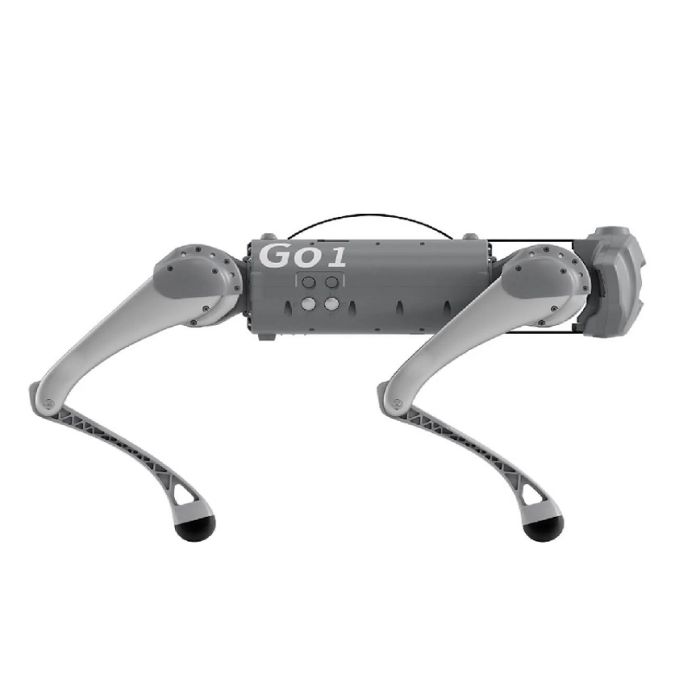
Out of stock
- BRAND:
- UNITREE ROBOTICS
- MODEL:
- GO1
- ORIGIN:
- China
- AVAILABILITY:
- SUBJECT TO AVAILABILITY
- SKU:
- Unitree-Go1
- Buy 2 for €3,651.92 €3,651.92 each and save 3%
- Buy 5 for €3,576.63 €3,576.63 each and save 5%
- Buy 10 for €3,463.68 €3,463.68 each and save 8%
Unitree Go1
As a four-legged mobile platform, the Go1 is commonly discussed in the context of robot dog systems that combine dynamic gait control with onboard sensing and developer-facing software interfaces. The robot is typically used in university labs, robotics startups, and industrial R&D settings to prototype autonomy, perception, and motion-control workflows without building a legged hardware stack from scratch.
Go1 is often characterized by its focus on accessibility (relative to earlier, higher-cost quadrupeds), a developer ecosystem that supports UDP-based command/control workflows, and compatibility with common robotics tooling. Research writing on the platform notes a software architecture that includes native support for ROS 1, with Unitree-provided pathways enabling ROS 2-based control by sending commands through a UDP interface.
Design and Features
Mechanical layout
The Go1 uses a four-legged morphology with articulated joints that enable a range of gaits (e.g., walking, trotting) and posture transitions (standing, crouching). Quadruped designs are widely adopted in robotics because they can combine stability (large support polygon in static stances) with mobility over uneven terrain, stairs, and clutter—conditions that can challenge wheeled bases.
Mobility and joint actuation
Unitree’s published marketing/specification materials for the Go1 emphasize high dynamic capability for its class, including a listed maximum running speed of up to 4.7 m/s and an actuator torque figure of approximately 23.7 N·m (noting that the real-world achievable speed depends on payload, gait selection, surface conditions, and safety limits configured in software).
Sensing and perception (typical configuration)
In many Go1 configurations, the robot integrates camera-based perception and inertial sensing used for stabilization and environment awareness. These sensors are commonly leveraged for visual-inertial odometry, obstacle detection, and navigation experiments, particularly in academic contexts.
Technology and Specifications
Control architecture
The Go1 is frequently controlled using a layered software approach:
-
Low-level control for joint commands, state estimation, and safety constraints (torque/position/velocity loops).
-
High-level behaviors that select gaits, velocities, and postures.
-
Autonomy layers (optional) for mapping, planning, and navigation via robotics middleware.
A robotics thesis describing the platform notes that Go1 includes native ROS 1 support, and that Unitree also made ROS 2 control approaches available that can communicate via UDP commands, allowing low-level access to motion control functions.
Developer interfaces (SDK ecosystem)
Unitree maintains a developer ecosystem around “legged” SDK components and ROS integration packages used across multiple quadruped products. In practice, Go1 development workflows often combine:
-
Vendor SDK/UDP interface for real-time control and telemetry
-
ROS nodes/bridges for sensor streams, state, and command topics
-
Simulation and algorithm development on a PC, then deployment/testing on hardware
(Exact package names and supported versions can vary by release and repository state.)
Physical characteristics (commonly referenced)
A Go1 user manual lists the robot weight as approximately 12 kg.
(Other parameters such as runtime, payload, and sensor suite can vary by configuration and variant, so they are typically confirmed against the specific SKU and documentation set.)
Applications and Use Cases
Robotics research and education
Go1 is widely used for:
-
Legged locomotion research (gait generation, stability control, model predictive control)
-
Reinforcement learning and imitation learning for locomotion and behaviors
-
Perception and navigation pipelines (visual SLAM, mapping, obstacle avoidance)
-
Multi-robot coordination experiments (when multiple units are available)
Because the platform is complete out-of-the-box, it is often used in coursework and capstone projects to demonstrate real-world integration of sensing, planning, and control.
Industrial prototyping
In applied R&D, Go1 can be used as a prototyping base for:
-
Remote inspection concepts in controlled environments
-
Payload experimentation (small cameras, sensors, lightweight grippers)
-
Human–robot interaction testing in labs and demo spaces
Algorithm benchmarking
Some teams use Go1 to benchmark:
-
Footstep planning approaches
-
State estimation performance under vibration and slip
-
Navigation stacks across ROS 1/ROS 2 workflows
Advantages / Benefits
Lower barrier to entry for legged robotics
Go1 is often positioned as an accessible quadruped platform for developers who want to work on autonomy and control without designing custom actuators, power systems, and mechanical assemblies.
Real-world testing beyond simulation
Legged robotics can be difficult to validate purely in simulation due to contact dynamics, slip, compliance, and terrain variation. A hardware platform allows researchers and engineers to observe real constraints, including thermal limits, traction changes, and sensor noise.
Ecosystem alignment with common tooling
The platform’s common integration patterns (vendor SDK + ROS-based pipelines) allow teams to reuse widely known robotics tools, including mapping, planning, and visualization workflows.
FAQ Section
What is the Unitree Go1?
The Unitree Go1 is a compact quadruped robot (robot dog) used for robotics education, research, and application development, providing a legged mobility platform with developer-facing control interfaces and common robotics software integration pathways.
How does the Unitree Go1 work?
Go1 combines electric actuators, onboard sensing, and a control stack that stabilizes the robot and executes gaits. Developers typically command motion through a vendor interface (often UDP-based) and integrate higher-level autonomy using robotics middleware such as ROS.
Why is the Unitree Go1 important?
Go1 is important because it lowers the cost and complexity of working with real legged-robot hardware, enabling students and engineering teams to validate locomotion, perception, and navigation systems outside simulation.
What are the benefits of the Unitree Go1?
Key benefits include an accessible entry point to quadruped locomotion, compatibility with common robotics development workflows, and performance characteristics highlighted in vendor materials (for example, a listed max speed up to 4.7 m/s).
Summary
The Unitree Go1 is a developer-oriented quadruped robot platform used widely in education and robotics R&D to explore legged locomotion, perception, and navigation. Its combination of dynamic mobility (as characterized in vendor specs), practical developer interfaces, and alignment with common robotics software workflows makes it a frequent choice for teams seeking a real-world robot dog platform for experimentation and prototyping.
Key Features:
- Exceptional Agility and Mobility: The Go1 boasts advanced locomotion capabilities, allowing it to walk, run, trot, jump, and even climb stairs with remarkable precision. Its compact and lightweight design makes it highly maneuverable in various terrains.
- Intelligent AI and Learning: Equipped with cutting-edge AI algorithms, the Go1 can perceive its environment, recognize objects, and learn from its experiences. This enables it to adapt to new situations and perform tasks autonomously.
- Customizable and Programmable: The Go1 is designed with an open API, allowing developers to create custom applications and integrate it with other systems. This makes it a versatile platform for research, development, and education.
- Robust and Durable: Built to withstand the rigors of real-world use, the Go1 is constructed from high-quality materials and rigorously tested for durability and reliability.
- Multiple Sensors and Perception: The Go1 is equipped with a suite of sensors, including cameras, LiDAR, and IMUs, providing it with a comprehensive understanding of its surroundings.
- Long Battery Life: The Go1's high-capacity battery ensures extended operation time, allowing you to explore and experiment for longer periods.
Specifications
| MODEL | GO1 |
|---|---|
| BRAND | UNITREE ROBOTICS |