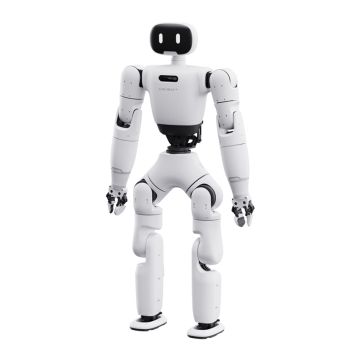
Agibot C2 Commercial Cleaning Robot (C2)
In stock
- BRAND:
- AGIBOT
- PART #:
- C2
- ORIGIN:
- China
- AVAILABILITY:
- SUBJECT TO AVAILABILITY
- SKU:
- AgiBot-C2
C2 Commercial Cleaning Robot (C2)
In the broader context of the AGIBOT product ecosystem, the manufacturer is associated with AgiBot (Zhiyuan Robotics / Shanghai Zhiyuan Innovation Technology Co., Ltd.), a Shanghai-based robotics company established in February 2023. Company materials describe a focus on “general-purpose embodied robots” and related application ecosystems.
Open, manufacturer-published technical documentation for the C2 itself is limited in widely accessible sources. As a result, the most verifiable public information about the C2 tends to be model identification and category (commercial cleaning robot), while detailed autonomy and cleaning-capability explanations are more readily available for related AGIBOT cleaning products—particularly the AGIBOT C5, which is described by the manufacturer as combining sweeping, scrubbing, and dust mopping and using multiple sensors for real-time obstacle avoidance.
Design and Features
Commercial floor-care form factor
Commercial cleaning robots in this segment are typically engineered around one core goal: consistent floor-care coverage with minimal operator supervision. They are generally designed to work in structured indoor environments (corridors, lobbies, open areas) while navigating around people, movable objects, and daily layout changes.
While the C2’s exact mechanical configuration (e.g., brush deck type, squeegee width, tank capacity) is not consistently published in open sources, the C2 is clearly positioned as a facility-grade cleaning platform rather than a small service robot.
Autonomy-first operation
Across the commercial cleaning category, autonomy is usually built around:
-
Route creation / teaching (so the robot can repeat a known cleaning pattern)
-
Coverage behaviors for large open spaces
-
Dynamic obstacle avoidance for safe operation in public environments
For example, Brain Corp describes two common route teach methods—Teach & Repeat and Area Fill—as standard ways to create and modify cleaning routes for autonomous cleaning systems.
Docking and reduced “robot tending”
A major differentiator in many enterprise deployments is whether the robot supports automated routines such as self-charging and (for scrubbers) water-service automation. The manufacturer’s description of the AGIBOT C5 explicitly highlights a “workstation” that enables self-charging, wastewater disposal, sewage tank rinsing, and fresh water refilling during use.
Even though this description is for the C5, it provides insight into the design direction of AGIBOT’s commercial cleaning line and the operational model many buyers expect in this category.
Technology and Specifications
What is publicly confirmed for the C2
Public listings for the C2 commonly confirm:
-
Model / part number: C2
-
Robot use: Cleaning
-
Brand: AGIBOT
-
Origin: China
-
Availability: “Subject to availability” / quote-oriented listing language
What is typically evaluated (and why it matters)
When a C2 buyer requests “specs,” procurement teams usually want a standardized set of metrics because they map directly to cost and performance:
-
Cleaning path width (affects coverage per hour)
-
Solution & recovery tank capacity (affects runtime between service)
-
Noise level (daytime vs after-hours suitability)
-
Productivity / coverage rate
-
Autonomy features (route teaching, obstacle avoidance, analytics)
-
Docking capabilities (charging and water-service automation)
A representative example from a widely documented autonomous scrubber is the Tennant Company T7AMR, which publishes coverage/productivity, tank capacities, and sound levels as core comparable specifications.
These are the same categories most facilities teams will request when evaluating the C2.
Autonomy and sensing (category-level context)
Because the C2’s sensor list is not consistently published in open sources, it is most accurate to describe autonomy capabilities at the category level while pointing to verified examples:
-
Route teaching and repeatability are common for scrubber robots deployed in retail, campuses, airports, and other structured environments.
-
Real-time obstacle avoidance is presented as a key capability in AGIBOT’s own description of its commercial cleaning robot line (documented for the C5).
In practice, C2 deployments are typically assessed not only on “can it clean,” but also on how safely and consistently it navigates during peak hours.
Applications and Use Cases
Commercial cleaning robots like the C2 are generally deployed in environments that combine large floor area, repeatable schedules, and high expectations for consistency:
-
Retail and shopping centers: frequent re-cleaning and predictable circulation spaces
-
Hospitality: quiet operation and off-peak cleaning schedules
-
Offices and corporate campuses: daily route repeatability and reporting
-
Education (schools/universities): open areas plus corridor networks
-
Airports and transportation hubs: long concourses and dynamic foot traffic
This operating model aligns with how autonomous scrubber systems are commonly positioned: automate the repetitive floor-care workload so staff can focus on detail cleaning and higher-value tasks.
Advantages / Benefits
Consistency and measurable routines
Autonomous route teaching enables repeatable cleaning patterns, which helps reduce variability between shifts and operators. Teach-and-repeat workflows are specifically cited as a route setup approach in commercial autonomy platforms.
Operational efficiency under labor constraints
Commercial cleaning teams often face staffing shortages or scheduling constraints; robot vacuum and scrubber systems are frequently positioned as tools that free staff time for more complex tasks rather than attempting to replace teams outright.
Reduced manual intervention with docking/workstations
Where workstation automation is available, daily operations can become substantially simpler—particularly for scrubbers that otherwise require frequent tank service. AGIBOT’s workstation concept (documented for the C5) explicitly targets these recurring service tasks.
Comparisons
C2 vs. AGIBOT C5 (within the same ecosystem)
The AGIBOT C5 is described by the manufacturer as combining sweeping, scrubbing, and dust mopping, using multiple sensors for obstacle avoidance, and supporting workstation-based automation.
By contrast, the C2 is publicly listed as a commercial cleaning robot but is often presented without the same depth of publicly accessible technical detail.
In buyer terms: the C5 has clearer published feature positioning, while C2 evaluation may rely more heavily on a formal datasheet/quote package.
C2 vs. autonomous scrubbers from established OEMs
Established manufacturers publish extensive specifications and global service coverage. The Tennant T7AMR provides a clear example of how OEMs disclose standardized performance metrics (tank capacity, sound level, cleaning path, productivity).
For procurement teams, the practical comparison often comes down to: service network + standardized consumables versus robotics platform capabilities + automation features.
C2 vs. robotics-native scrubber platforms
Robotics-focused companies such as Avidbots position autonomous scrubbing as a way to deliver consistent, measurable cleaning while reallocating staff time.
These systems often emphasize autonomy software, reporting, and scalability across multiple facilities—criteria that buyers may also apply when evaluating the C2.
C2 vs. vacuum-focused commercial robots
Vacuum-focused systems—such as SoftBank Robotics’s Whiz—are designed primarily for vacuuming and are marketed as a way to free time for deeper cleaning and process compliance.
This comparison matters because vacuum robots and scrubber robots serve different floor-care needs; sites with hard-floor scrubbing requirements usually evaluate scrubber-dryer style machines first.
Pricing and Availability
Public listings frequently describe the C2 as in stock but “subject to availability,” and they often present the purchasing workflow as request-a-quote rather than a fixed public price.
For context within the same commercial-cleaning family, at least one reseller listing shows the AGIBOT C5 with a published price (example: US$ 32,900), illustrating how pricing can vary by model and region—and how some models are quote-based while others are priced openly.
In practice, total ownership cost is typically influenced by the bundle: robot configuration, docking/workstation options, software/fleet tools, warranty, training, and service terms.
FAQ Section
What is the Agibot C2 Commercial Cleaning Robot (C2)?
The Agibot C2 (C2) is a commercial cleaning robot model listed under the AGIBOT brand for facility floor-cleaning use. Public listings confirm the model number (C2) and categorize it as a cleaning robot, often sold through quote-based channels.
How does the Agibot C2 (C2) work?
Commercial cleaning robots typically operate by following taught routes or coverage patterns, navigating safely around obstacles, and performing a floor-care routine. In this category, route creation commonly uses “teach and repeat” or “area fill” methods.
Why is the Agibot C2 (C2) important?
Robotic floor cleaning helps facilities maintain consistent coverage and reduce repetitive manual workload, allowing cleaning teams to focus on detailed tasks and service quality. This “amplify the team” benefit is a common theme across commercial robot cleaning systems.
What are the benefits of the Agibot C2 (C2)?
Benefits commonly associated with this class of robot include repeatable cleaning routines, consistent coverage, and reduced labor for repetitive floor-care tasks—especially when paired with automated docking/workstation concepts for charging and (where applicable) tank service.
Summary
The Agibot C2 Commercial Cleaning Robot (C2) is positioned as a professional, facility-focused cleaning robot identified publicly by its C2 model designation and commercial availability through quote-based channels. While open-web sources provide limited C2-specific technical detail, the broader commercial cleaning robot category—and AGIBOT’s own published descriptions for related models such as the C5—highlight the key attributes most buyers evaluate: route-based autonomy, safe navigation with obstacle avoidance, operational consistency, and (where available) docking/workstation automation that reduces routine manual intervention. For organizations seeking scalable, repeatable floor-care operations, the C2 fits within a fast-growing class of commercial cleaning robots designed to standardize outcomes and improve facility efficiency.
Specifications
| PART # | C2 |
|---|---|
| ROBOT USE | CLEANING |
| BRAND | AGIBOT |