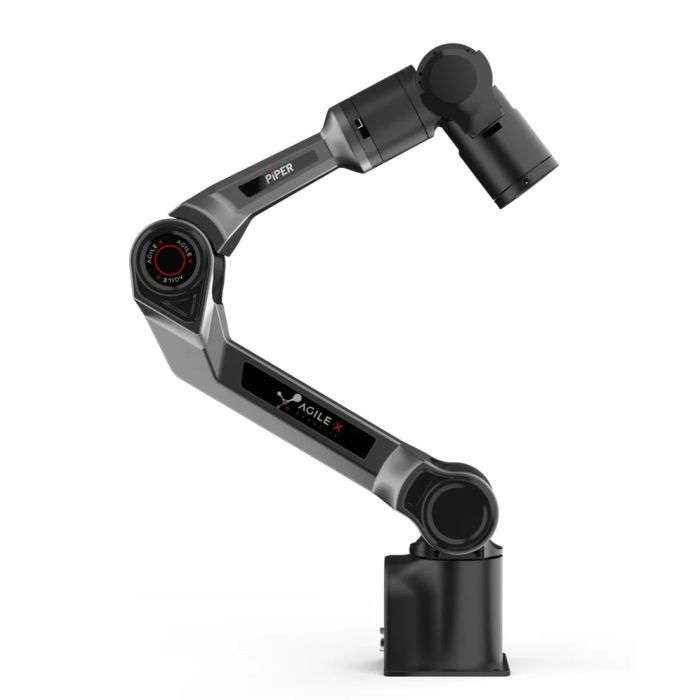
Agilex Piper Lightweight Robotic Arm
In stock
- BRAND:
- AGILEX
- PART #:
- PiPER
- ORIGIN:
- China
- AVAILABILITY:
- SUBJECT TO AVAILABILITY
- SKU:
- AgileX-PiPER
Agilex Piper Lightweight Robotic Arm
Agilex Piper (PiPER)
PiPER is commonly described as a 6-DOF (degrees of freedom) articulated arm with an integrated controller and joint motors, designed to deliver precise motion while remaining small enough to mount on benches, mobile robots, and compact workcells.
Design and Features
Lightweight mechanical structure
PiPER is positioned as a lightweight manipulator built around an aluminum alloy frame with a plastic/polymer shell, balancing stiffness and mass for desktop and mobile use. The arm’s published mass is 4.2 kg, supporting deployments where payload and mounting constraints are strict.
Integrated controller and simplified wiring
A key product design choice is the integrated controller, reducing external boxes and cabling compared with many traditional arms. The quick-start manual specifies power and CAN interfaces as external connections on the standard configuration.
Motion precision and repeatability
PiPER is marketed around a repeatable motion profile suitable for teaching, demonstration, and repeatable handling tasks. Official materials list ±0.1 mm repeatability. For many classroom and prototyping scenarios, this level of repeatability is intended to support consistent pick-and-place, light assembly demonstrations, and validation of motion planning algorithms.
Teaching and developer workflows
PiPER supports multiple operating modes commonly used in education and prototyping:
-
Teach-by-dragging (hand-guiding)
-
Offline trajectory workflows
-
PC/host-computer control and API-based control
AgileX also promotes open-source support and control via Python API, plus support for ROS1 and ROS2, which are widely used in robotics research and curriculum development.
Technology and Specifications
Core specifications (published)
AgileX’s published PiPER specifications include:
-
Degrees of freedom: 6
-
Payload (effective load): 1.5 kg
-
Arm weight: 4.2 kg
-
Working radius / reach: ~626–626.75 mm
-
Repeatability: ±0.1 mm
-
Power supply: DC 24V (manual notes 24–26V range)
-
Power consumption: max ≤120 W; “comprehensive” ≤40 W (manual wording)
-
Operating environment: −20°C to 50°C; humidity 25%–85% (non-condensing); noise <60 dB
-
Base mounting pattern: 70 mm × 70 mm, M5 × 4
Joint ranges and speed (motion envelope)
The quick-start manual lists joint motion ranges and maximum joint speeds, reflecting the intended “fast motion” capability in a compact form factor. Examples include:
-
Joint ranges: J1 ±154°, J2 0°–195°, J3 −175°–0°, J4 −106°–106°, J5 −75°–75°, J6 ±100°
-
Max joint speeds: up to 225°/s on J4–J6 (manual table)
Communication and software ecosystem
PiPER’s quick-start manual identifies CAN as the communication method for the arm. On the software side, AgileX publishes:
-
A Python SDK (“piper_sdk”) distributed via PyPI/GitHub and built around python-can dependencies
-
A ROS workspace/driver package (“piper_ros”) with documentation and setup guidance
-
A GitHub organization page that groups PiPER Series resources (SDK, ROS driver, UI tools, demos)
This combination is commonly positioned for robotics curricula and lab use, where rapid integration into ROS toolchains, simulation, and perception stacks is a frequent requirement.
Optional gripper and teaching accessories
AgileX’s quick-start manual also documents optional end-effector and teaching accessories, including a two-finger “follower” gripper and a “leader” teaching device (for teleoperation/teaching workflows). The follower gripper specs include 0–70 mm opening distance, 40 N rated clamping force, 50 N max clamping force, and DC 24V supply, with CAN communication and integrated controller.
Applications and Use Cases
Education and robotics research
PiPER is frequently positioned as a robotic arm for education and research due to its manageable size, published repeatability, and accessible tooling (drag teaching, offline trajectories, Python/ROS support). Typical lab use cases include:
-
Motion planning and trajectory generation experiments
-
Manipulation pipeline testing (perception → planning → grasp → place)
-
Dataset collection for learning-based robotics, where repeated movements and consistent kinematics are valuable
Desktop automation and light industrial tasks
With a 1.5 kg payload and compact mounting footprint, PiPER is often considered for bench-top automation tasks such as sorting, simple pick-and-place, test-fixture handling, and light assembly demonstrations (where tooling and safety assessment are properly addressed).
Mobile manipulation and integrated robot platforms
AgileX explicitly frames PiPER as compatible with AgileX robotics products in the quick-start manual, aligning with a common market pattern: pairing a compact arm with an AgileX mobile base to create a mobile manipulation platform. In this configuration, PiPER can serve as a practical arm for indoor lab navigation + manipulation demos.
Advantages / Benefits
Practical balance of capability and deployability
PiPER targets a middle ground between toy-scale arms and heavy industrial manipulators: a 6-axis motion envelope, 1.5 kg payload, and ~626 mm reach in a 4.2 kg package. This balance can reduce infrastructure requirements (bench space, mounting hardware, transport constraints) for schools and labs.
Developer-friendly control options
PiPER supports both “teaching” style workflows (drag teaching, offline trajectories) and developer workflows (Python SDK, ROS integration), enabling a wide spectrum of users—from beginners to robotics engineers—to work on the same hardware platform.
Environmental robustness for field-like testing
AgileX advertises operation from −20°C to 50°C, which can be relevant for labs doing environmental testing, warehouse-like conditions, or unconditioned spaces, subject to safe operating practices and appropriate risk controls.
FAQ Section
What is AgileX PiPER (PiPER)?
AgileX PiPER is a 6-DOF lightweight robotic arm designed for education, research, and light automation, offering a 1.5 kg payload, ~626 mm reach, and ±0.1 mm repeatability in a compact system.
How does AgileX PiPER work?
PiPER uses six actuated joints controlled through an integrated controller and is typically operated via drag teaching, offline trajectories, or software control using CAN communication, with developer options including a Python SDK and ROS1/ROS2 support.
Why is AgileX PiPER important?
Compact robot arms like PiPER can make manipulation research and robotics education more accessible by reducing setup complexity while still supporting realistic reach, payload, and repeatability for applied projects.
What are the benefits of AgileX PiPER?
Published benefits include a 4.2 kg arm mass, 1.5 kg payload, ~626 mm reach, ±0.1 mm repeatability, broad developer tooling (Python SDK, ROS support), and a rated operating range of −20°C to 50°C.
Summary
AgileX PiPER (PiPER) is a compact 6-DOF robotic arm positioned for education, research, and light automation, combining 1.5 kg payload, ~626 mm reach, and ±0.1 mm repeatability with an integrated controller and practical teaching/developer workflows. Its support for drag teaching, offline trajectories, CAN-based control, and an open developer ecosystem (Python SDK and ROS tooling) makes it a common fit for labs and integrators seeking a portable manipulator for manipulation pipelines, prototyping, and embodied AI data-collection tasks.