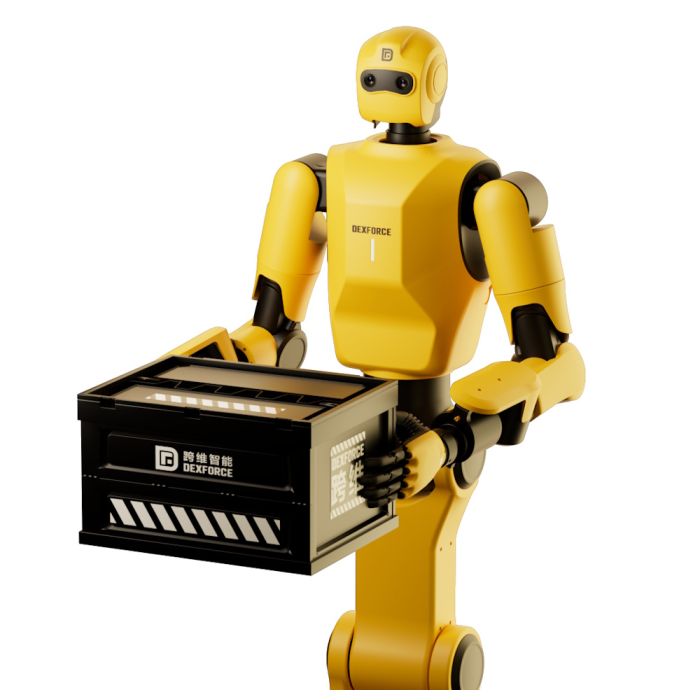
Dexforce W1 Pro General Purpose Embodied Intelligence Wheeled Humanoid Robot (W1 Pro)
In stock
- BRAND:
- DEXFORCE
- PART #:
- W1 Pro
- ORIGIN:
- China
- AVAILABILITY:
- SUBJECT TO AVAILABILITY
- SKU:
- DexForce-W1-Pro
The DexForce W1 Pro is Interdimensional's second-generation universal embodied intelligent robot. As the industry's first AI-defined, highly versatile humanoid robot, the W1 Pro is centered around Interdimensional's DexVerse™ embodied intelligence engine. Its "massive data generation + efficient simulation" approach enables direct deployment of real devices in multiple environments and rapid application switching. At the body level, the W1 Pro utilizes a highly humanoid structure and 34 power units, enabling high flexibility and multi-scenario versatility. Combined with Interdimensional's pure visual spatial intelligent sensors, it provides real-time perception and precise control.
DexForce W1 Pro General Purpose Embodied Intelligence Wheeled Humanoid Robot (W1 Pro)
Introduction / Overview
The DexForce W1 Pro (often written W1 Pro) is a general-purpose embodied intelligence wheeled humanoid robot developed by DexForce (跨维智能). It combines a humanoid upper body (head/torso, dual arms, and interchangeable end-effectors) with a wheeled mobile base designed for stable indoor autonomy and long-duration operation. DexForce presents the W1 Pro as its second-generation general-purpose embodied intelligence robot, emphasizing rapid scenario switching through simulation-driven development and vision-first perception. World Robot Conference+1
DexForce describes the W1 Pro as an “AI-defined” humanoid platform centered on its DexVerse™ embodied intelligence engine, with an emphasis on “massive data generation + efficient simulation” to accelerate real-environment deployment and application switching across multiple settings. World Robot Conference+1
Design and Features
Wheeled humanoid architecture
The W1 Pro uses a hybrid structure: a humanoid upper body for manipulation and interaction, paired with a wheeled chassis for mobility. DexForce lists configurable base options, including a differential-drive chassis and an optional omnidirectional chassis, enabling the platform to prioritize either simplicity/cost (differential) or maneuverability (omni) depending on the deployment.
Configurable “full-body” and “half-body” variants
DexForce’s published configuration table describes full-body and half-body versions, intended for different operational modes (autonomous mobile scenarios versus stationary/bench-style operation). The company positions both variants for common industries such as data collection/training, research/education, commercial services, and industrial manufacturing.
Modular hands, grippers, and arm options
DexForce emphasizes “on-demand adaptation,” including selectable dexterous hands or two-finger grippers, plus arm configurations described as humanoid-style or industrial-style options. The standard configuration table lists a dexterous hand as standard for W1 Pro, with a two-finger gripper as an option (and the reverse for the W1 Core line).
High-frequency control and industrial networking
The platform is marketed around real-time control and industrial integration. DexForce highlights 1000 Hz whole-body joint control, EtherCAT industrial networking, and high-bandwidth communication between power units.
Technology and Specifications
Degrees of freedom and actuation
DexForce describes two mobility configurations with different whole-body DoF counts:
-
Up to 40 DoF for an omnidirectional chassis configuration
-
34 DoF for a differential-drive configuration
In addition, the World Robot Conference listing describes the W1 Pro as having 34 powered units, consistent with the differential-drive whole-body DoF configuration.
Dimensions and mobility performance
DexForce lists a standing size of 682 mm × 550 mm × 1636 mm (L×W×H) for the W1 Pro.
For mobile performance (differential base), DexForce lists:
-
Maximum straight-line speed: 1.5 m/s
-
Rated straight-line speed: 1.2 m/s
For navigation accuracy (when using SLAM navigation), DexForce lists a repeat positioning accuracy of ≤ ±20 mm, ±2°.
Manipulation: arms, payload, and repeatability
DexForce specifies 7-DoF per arm (shoulder 3, elbow 1, wrist 3) and a maximum payload of 10 kg per arm. The company also lists arm repeat positioning accuracy (excluding the hand) of ±0.5 mm.
For end-effectors, DexForce describes:
-
Dexterous hand: 6 active DoF per hand (five-finger, human-like scheme)
-
Two-finger gripper: 1 DoF
Perception and sensor stack
DexForce positions W1 Pro as a “pure-vision” humanoid with binocular perception. Published elements include:
-
Humanoid binocular “pure vision” sensor with a 6 cm baseline
-
Optional wrist RGBD camera(s) (mountable on both hands)
-
Two navigation LiDAR units (mounted diagonally on the chassis)
-
Two navigation/obstacle-avoidance cameras (front and rear, centered on the chassis)
DexForce also describes a second-generation binocular vision sensor with higher frame rate, lower power, and improved accuracy compared to a prior generation (as presented on its W1 Pro page).
Control architecture, compute, and power
DexForce describes a compute/control architecture designed for embodied AI workloads and real-time motion:
-
Dual-PC architecture (standard configuration for W1 Pro)
-
Total compute: ≥ 300 TOPS (with an option to increase compute via dual-PC hardware)
-
Motion control frequency: 1 kHz
-
Battery capacity: 40 Ah
-
Endurance: ≥ 8 hours (for W1 Pro)
DexForce also lists “secondary development” (developer extensibility) and “teleoperation” as supported, with optional accessories including VR goggles and an optional automatic charging dock.
Embodied intelligence software: DexVerse™, EmbodiChain, and Sim2Real VLA
DexForce positions W1 Pro around a simulation-to-reality pipeline. On its W1 Pro page and conference listing, the company emphasizes:
-
DexVerse™ embodied intelligence engine
-
Simulation-based pipelines that generate large-scale data and support rapid deployment across scenarios
-
EmbodiChain (Sim2Real simulation engine for data generation and model training) and a Sim2Real VLA model framework.
For company-level context, DexForce’s LinkedIn profile describes the firm as founded in June 2021, focused on embodied intelligence R&D with Sim2Real as a core driver, and centered on DexVerse™ capabilities spanning simulation generation and model training.
Applications and Use Cases
Industrial and commercial task automation
DexForce markets W1 Pro as a multi-scenario platform aimed at real deployments rather than a single-purpose demonstrator. Example scenarios shown on the W1 Pro page include:
-
Coffee making
-
Data collection
-
Smart manufacturing
-
Power inspection
-
Commercial services
-
High-end elderly care
These reflect the robot’s core positioning: combining mobility and manipulation with perception and AI workflows to operate in structured indoor environments (production floors, service areas, labs, and training sites).
Data collection and embodied AI training
A recurring theme in W1 Pro marketing is “data collection” and “training,” aligning with DexForce’s emphasis on simulation-driven pipelines (EmbodiChain / Sim2Real VLA) and vision-based perception. In practice, such platforms are commonly used to record demonstrations, generate datasets for manipulation policies, and validate behaviors in controlled facilities before broader rollout.
Research and education
DexForce explicitly lists research and education among the typical industry categories for both mobile and stationary variants, consistent with the W1 Pro’s developer extensibility, teleoperation support, and modular sensor/end-effector options.
Advantages / Benefits
Stable mobility for long-duration operation
Compared with biped humanoid designs, a wheeled base generally reduces balance complexity and energy consumption for locomotion, enabling longer runtime and simpler indoor navigation. DexForce’s own specification table underscores this strategy by emphasizing ≥8h endurance, a controlled SLAM navigation stack, and a configurable chassis.
High-precision manipulation with industrial-grade control
The combination of 7-DoF arms, 10 kg per-arm payload, and ±0.5 mm repeatability positions W1 Pro toward tasks that benefit from repeatable arm trajectories—especially when paired with wrist sensing and vision-based perception.
Faster scenario switching via Sim2Real workflows
DexForce frames the W1 Pro around rapid deployment across environments through simulation + data generation, describing fast switching between applications and multi-environment real-machine deployment. This “engine-led” approach is intended to reduce time spent hand-tuning behaviors for each new site or task.
FAQ Section
What is the DexForce W1 Pro?
The DexForce W1 Pro is a general-purpose embodied intelligence wheeled humanoid robot that combines a wheeled mobile chassis with a humanoid upper body, dual 7-DoF arms, and configurable hands/grippers for multi-scenario tasks.
How does the DexForce W1 Pro work?
W1 Pro pairs vision-first perception (binocular “pure vision,” optional wrist RGBD, plus navigation sensors) with real-time control (1 kHz motion control and EtherCAT networking) and DexForce’s DexVerse™/Sim2Real development pipeline to train and deploy behaviors across environments.
Why is the DexForce W1 Pro important?
W1 Pro represents a design approach to embodied AI focused on practical indoor deployment: stable wheeled mobility, long endurance (≥8h), and modular manipulation—combined with simulation-driven workflows intended to speed up new-task and new-site rollout.
What are the benefits of the DexForce W1 Pro?
Key benefits cited in DexForce’s published materials include configurable mobility (differential/omni), high-precision manipulation (10 kg per arm; ±0.5 mm repeatability), multi-sensor perception, high-frequency control (1 kHz), ≥300 TOPS compute, and ≥8h endurance, supporting industrial, commercial, and research deployments.
Summary
The DexForce W1 Pro is a configurable wheeled humanoid embodied intelligence platform designed to balance long-duration indoor mobility with high-precision manipulation. With published specs such as 7-DoF arms, 10 kg per-arm payload, ±0.5 mm repeatability, SLAM navigation (≤±20 mm, ±2° repeat positioning), ≥300 TOPS compute, 1 kHz control, and ≥8h endurance, the W1 Pro is positioned for multi-scenario deployment across commercial services, data collection/training, and industrial workflows—supported by DexForce’s DexVerse™ / Sim2Real development approach for faster task adaptation.