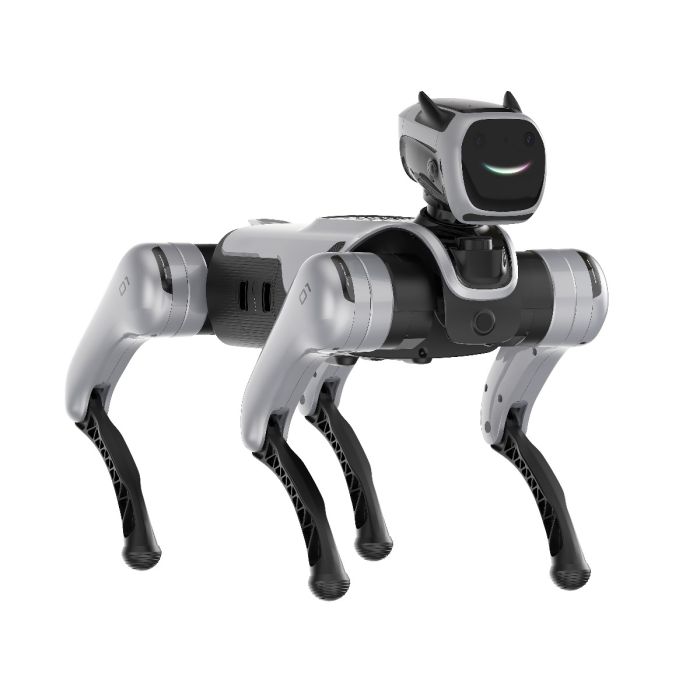
MagicLab MagicDog Quadruped Robot
In stock
- BRAND:
- MAGICLAB
- MODEL:
- MAGICDOG
- ORIGIN:
- China
- Warranty:
- 12 MONTHS
- AVAILABILITY:
- SUBJECT TO AVAILABILITY
- SKU:
- MagicLab-MagicDog
MagicLab MagicDog Quadruped Robot
MagicDog sits within a family of MagicLab “MagicDog” products that includes the standard legged MagicDog, the wheeled MagicDog-W, and the larger MagicDog Y1. The standard MagicDog is the smallest and most consumer- or education-friendly member of that line, while the company also maintains official SDK and ROS2 documentation specifically for MagicDog and MagicDog-W.
In practical terms, MagicDog combines quadruped locomotion, interactive sensing, camera features, app-style programmability, and developer access. That makes it relevant to schools, robotics clubs, STEM labs, universities, demo spaces, and developers who want a legged robot that is more capable than a toy but less complex than a large industrial quadruped. This is an inference based on MagicLab’s product positioning, published specifications, and documentation stack.
Design and Features
Compact Quadruped Form Factor
MagicDog uses a compact quadruped body with 13 degrees of freedom, including 12 aluminum-alloy precision joint motors plus body articulation. MagicLab describes it as a high-degree-of-freedom design with low-noise, high-torque electric motors, which supports expressive motions and agile gait control.
Official specifications list standing dimensions of 670 × 350 × 560 mm, lying dimensions of 720 × 440 × 290 mm, and a net weight of 15.8 kg excluding battery. Those numbers place it in a portable class suitable for classrooms, labs, and indoor demos while still being large enough to carry sensors and perform dynamic movement.
Expressive Motions and Interaction
One of MagicDog’s most marketable features is its ability to perform more than 30 high-difficulty poses or stunts, including backflips, moonwalk-style motions, handshakes, and stretching actions. MagicLab highlights these moves as part of the robot’s appeal as an intelligent companion and demonstration platform.
The robot is also designed for social or entertainment-style interaction. MagicLab’s Chinese product page says the platform supports language, vision, and touch-based perception and interaction, while the English page emphasizes creative programming and dog-perspective media capture. Because the English page is more restrained than the Chinese page, it is safest to say MagicDog is clearly designed for multimodal interaction, with the exact feature set varying somewhat by market page and configuration.
4K Head Camera
MagicDog includes a 4K HD lens mounted in the head. MagicLab says this allows one-click photo and video capture from a dog-like perspective, which is a distinctive feature for content creation, demonstrations, telepresence-like experiences, and educational engagement.
Free Programming and Creative Use
MagicLab explicitly promotes graphical programming for MagicDog, describing it as simple and intuitive. That positions the robot not just as a closed appliance but as a programmable quadruped suitable for STEM instruction, motion design, classroom robotics, and beginner-friendly experimentation.
Technology and Specifications
Locomotion and Mobility
MagicDog’s official spec table lists a maximum speed of 3.0 m/s, a payload of about 5 kg with maximum payload around 10 kg, a maximum obstacle height of 15 cm, and a maximum climbing angle of 40°. These figures suggest the robot is designed for agile indoor and light outdoor terrain rather than purely flat-floor operation.
MagicLab also states that MagicDog can actively overcome obstacles and adapt to uneven ground such as slopes and gravel paths. That supports use in research demos and outdoor campus environments where terrain variation matters more than it would for a standard wheeled robot.
Sensing and Perception
The product page says MagicDog uses single-line LiDAR, stereo cameras, and RealSense technology together to identify seven categories of obstacles. This sensor combination is notable because it blends range sensing, stereoscopic vision, and depth perception into a relatively compact quadruped platform.
That sensing stack is important for navigation, obstacle detection, and terrain adaptation. It also makes MagicDog more relevant to educational robotics and light research than a simpler programmable robot dog with only remote-control behaviors. This is an inference from the published sensor configuration and obstacle-handling claims.
Actuation and Power
MagicDog uses a high power density actuation unit with maximum joint torque of approximately 37.5 N·m and maximum power of 3200 W. MagicLab also lists an operating voltage range of 22V–36V and an 8-core high-performance CPU as the basic onboard computing platform.
These figures place MagicDog well above hobby-grade robot pets in mechanical capability, even though it remains much smaller than industrial quadrupeds. The result is a middle-ground platform: compact enough for education and demonstrations, but strong enough for meaningful locomotion and SDK-based development. That comparison is an inference based on the published numbers.
Developer Stack and SDK Support
A major strength of the MagicDog platform is that MagicLab publicly maintains a MagicDog Development Guide with C++ API, Python API, examples, and ROS2 API documentation. The documentation includes sections for robot main control, high-level and low-level motion control, sensor control, audio control, state monitoring, SLAM navigation control, and display control.
That means MagicDog is not just a showcase robot. It is also a developer platform with official support for programming and robotics integration. For schools and labs, this is one of the clearest reasons to view it as a serious STEM or research tool rather than only an entertainment robot.
Applications and Use Cases
STEM Education and Classroom Robotics
MagicDog is well suited to STEM education, especially in robotics clubs, engineering classrooms, and coding workshops. The combination of graphical programming, visible legged locomotion, built-in sensors, and official developer documentation makes it useful for teaching motion control, sensing, embodied AI concepts, and robot behavior design.
Research and Algorithm Development
Because MagicLab provides SDKs in C++, Python, and ROS2, MagicDog can also serve as a platform for locomotion research, SLAM experiments, perception testing, and robotics software development. Its compact size makes it easier to deploy in smaller labs than larger quadrupeds, though it is still clearly more advanced than a toy or basic educational robot.
Demonstrations, Exhibitions, and Public Interaction
MagicDog’s expressive motions, camera system, and companion-style design make it a good fit for trade shows, museums, innovation centers, brand activations, and public demonstrations. The ability to perform stunts and capture 4K media from a dog’s perspective gives it both educational and entertainment value.
Maker Projects and Creative Robotics
The robot’s programmability and payload capacity also make it relevant for maker projects and add-on development, especially where users want to test custom behaviors or integrate lightweight sensors and accessories. That use case is inferred from the payload spec, SDK availability, and the broader MagicLab ecosystem of components and documentation.
Advantages / Benefits
One major benefit of MagicDog is its balance of accessibility and capability. It is smaller and less intimidating than industrial quadrupeds, but it still offers 13 DoF, a meaningful sensor stack, obstacle handling, and official APIs.
A second benefit is its developer readiness. Many robot dogs are either consumer gadgets with limited openness or enterprise platforms with high complexity and cost. MagicDog stands out because MagicLab openly publishes structured developer documentation across multiple programming interfaces.
A third advantage is versatility. The robot can be used for education, demos, creative interaction, and entry-level research. That breadth does not mean it replaces larger industrial inspection quadrupeds, but it does make MagicDog appealing to institutions that want one platform for multiple robotics purposes. This is an inference based on its published features and support ecosystem.
FAQ Section
What is the MagicLab MagicDog Quadruped Robot?
The MagicLab MagicDog is a compact four-legged robot with 13 degrees of freedom, onboard sensing, a 4K head camera, and official SDK support for education, demonstrations, and robotics development.
How does the MagicLab MagicDog work?
MagicDog uses high-torque electric joint motors, an onboard CPU, and a perception stack that includes single-line LiDAR, stereo cameras, and RealSense to move, detect obstacles, and support programmable behaviors.
Why is the MagicLab MagicDog important?
It is important because it offers a middle ground between toy robot pets and large industrial quadrupeds: compact enough for classrooms and demos, but advanced enough to support C++, Python, and ROS2 development.
What are the benefits of the MagicLab MagicDog?
Its main benefits include compact quadruped mobility, obstacle sensing, expressive stunt motions, 4K media capture, and official SDK support for learning and development.
Does MagicLab MagicDog support ROS2?
Yes. MagicLab’s documentation center includes a ROS2 SDK User Guide and Quadruped Robot ROS2 SDK Documentation for the MagicDog platform.
What is the payload of MagicLab MagicDog?
MagicLab lists MagicDog with an approximate 5 kg payload and a maximum payload around 10 kg.
Summary
The MagicLab MagicDog Quadruped Robot is a compact, sensor-equipped robot dog designed for a broad middle ground between education, public interaction, and developer experimentation. Its key strengths are 13 DoF locomotion, obstacle sensing with LiDAR and vision, a 4K head camera, 3.0 m/s top speed, and official C++, Python, and ROS2 support. For schools, makerspaces, universities, and demo environments looking for a capable programmable quadruped, MagicDog stands out as a flexible and technically credible platform.