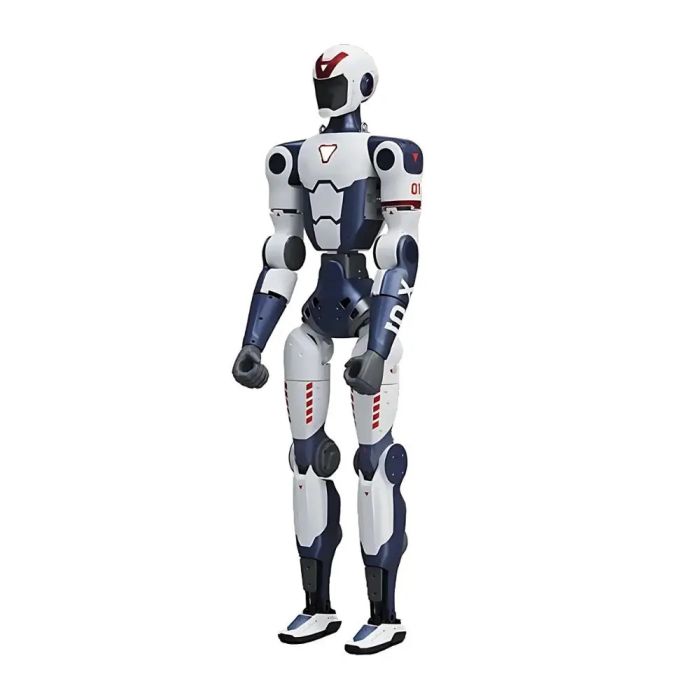
Unitree R1 Edu Pro A Humanoid Robot (R1 EDU U3)
In stock
- BRAND:
- UNITREE ROBOTICS
- MODEL:
- EDU PRO A
- PART #:
- R1 EDU U3
- ORIGIN:
- China
- Warranty:
- 12 MONTHS
- AVAILABILITY:
- PRE-ORDER
- SKU:
- Unitree-Robotics-R1-EDU-U3
Onboard compute and connectivity
The R1 Edu Pro A is described as including an 8-core high-performance CPU as baseline computing, along with Wi-Fi 6 and Bluetooth 5.2.
The same listing also references an upgrade path via an expansion dock that can raise built-in computing capability to a stated “100 TOPS” and mentions AI algorithm support for secondary development.
Technology and Specifications
Onboard compute and connectivity
The R1 Edu Pro A is described as including an 8-core high-performance CPU as baseline computing, along with Wi-Fi 6 and Bluetooth 5.2.
The same listing also references an upgrade path via an expansion dock that can raise built-in computing capability to a stated “100 TOPS” and mentions AI algorithm support for secondary development.
Perception and audio I/O
For perception, the configuration lists an anthropomorphic binocular camera, a common sensor choice for depth-related tasks such as obstacle detection, visual tracking, and basic scene understanding. It also notes a speaker and microphone array as standard, supporting voice prompts, simple audio interaction, or data collection for HRI experiments.
Power system and battery life
The R1 Edu Pro A uses a lithium battery power supply and lists an approximately 1-hour battery life, with a “smart battery” described as quick-release.
Developer enablement and simulation
The product listing explicitly emphasizes secondary development support and states that it provides robot models and simulation interfaces compatible with simulation environments such as NVIDIA Isaac Sim.
It also notes smart OTA upgrades, which can be relevant in educational settings where multiple robots need consistent firmware/software baselines.
Background: The R1 EDU Lineup and the Pro A's Position
The R1 EDU series was developed alongside the consumer R1 variants as a parallel product family addressing the research and education market, which has distinct requirements from the consumer market: unrestricted programmatic access to the robot through a full SDK, ROS 2 integration with the standard academic robotics software ecosystem, dedicated AI compute beyond the base 8-core processor, and optionally dexterous end-effectors for manipulation research. BotInfo.ai's EDU analysis describes the strategic intent clearly: "While the consumer-focused Unitree R1 Basic garnered headlines for democratizing humanoid robotics, the R1 EDU series is where serious research happens."
The R1 EDU lineup consists of seven configurations. The R1 EDU Pro A (U3) is within the Pro tier — the highest available specification level in the R1 EDU family — distinguished from lower EDU variants by the inclusion of the NVIDIA Jetson Orin compute module, up to 40 degrees of freedom, the optional dexterous hand, and enhanced head mobility. The designation "U3" refers to Unitree's internal product configuration code distinguishing this specific DOF and accessory combination from the Pro B, Pro C, and Pro D configurations within the same price tier.
Design and Physical Features
Compact but Capable: 121 cm at 25 Kilograms
The R1 EDU Pro A shares the same physical frame as all R1 variants — 121 to 123 centimeters in height, 25 kilograms in weight, with dimensions of approximately 1230 x 357 x 190 mm (height x width x thickness). This compact, lightweight form factor is a deliberate design choice that serves research purposes in ways that full-size humanoids cannot: a single researcher can physically move, reposition, and transport the robot without assistance; fall recovery incidents and hardware damage during policy exploration are lower-consequence than with a 70 to 85-kilogram full-size platform; and the robot operates comfortably within standard laboratory and classroom environments without requiring dedicated floor-level workspace.
The 25-kilogram mass is achieved through the use of composite materials and engineering polymers rather than the metal-frame construction of Unitree's G1 (35 kg) and H2 (70 kg). This material strategy contributes to the R1's lower price relative to the G1 while reducing weight — a design trade-off that accepts lower structural rigidity and payload capacity for the portability, cost, and manipulation research context where the R1 EDU Pro A is deployed.
Up to 40 Degrees of Freedom: The R1 EDU's Highest DOF Count
The R1 EDU Pro A's most significant physical differentiation from the base R1 and R1 Basic is its up to 40 degrees of freedom — doubling the 20 DOF of the R1 Air and substantially exceeding the 26 DOF of the standard R1 Basic. This expanded DOF count is achieved through:
Enhanced arm articulation beyond the standard R1 arm configuration, enabling greater arm workspace coverage and more complex arm-hand coordination for manipulation tasks.
Dexterous hand integration — the optional dexterous hand adds finger-level degrees of freedom enabling grasp configurations from power grips through precision pinch that the standard end-effectors cannot replicate.
Dual-DOF head mobility providing both pan and tilt for active visual tracking during locomotion and manipulation, improving the robot's ability to maintain fixation on task-relevant targets during dynamic whole-body motion.
Waist articulation adding waist yaw and roll (up to ±150° yaw, ±30° roll per the standard R1 specifications) that the R1 Air lacks, enabling the whole-body coordination required for tasks requiring torso lean, reach extension, and object handover from the ground to standing height.
Optional Dexterous Hand
The optional dexterous hand for the R1 EDU Pro A is the single feature that most clearly distinguishes it from the standard R1 EDU configurations: five-finger dexterous manipulation capability in a robot at the $20,000 to $35,000 price range. For manipulation researchers, the dexterous hand transforms the R1 EDU Pro A from a locomotion and interaction research platform into a full-spectrum embodied AI research platform — capable of studying not only how the robot walks, navigates, and interacts verbally, but how it grasps, manipulates, and hands objects across the full range of human grasping postures.
The hand option is listed as "optional" by RobotShop's product description, reflecting that not all buyers need dexterous manipulation capability — buyers studying locomotion or HRI without manipulation tasks can opt out and take the price and weight savings.
Technology and Specifications
R1 EDU Pro A (U3) Core Specifications
| Specification | Value |
|---|---|
| Height | ~121 cm (4 ft) |
| Weight | ~25 kg (55 lb) |
| Total DOF (Maximum) | Up to 40 |
| Head DOF | 2 (dual-DOF enhanced head) |
| Waist DOF | 2 (yaw ±150°, roll ±30°) |
| Dexterous Hand | Optional (adds finger DOF) |
| Main Compute | 8-core high-performance CPU/GPU |
| Optional AI Compute | NVIDIA Jetson Orin 16G (100 TOPS) |
| Wireless Connectivity | WiFi 6, Bluetooth 5.2 |
| Cameras | Binocular stereo cameras |
| Audio | 4-microphone array, stereo speakers |
| AI Models | UnifoLM large multimodal model |
| Battery | Quick-swappable, approximately 1 hour |
| OTA Updates | Yes |
| Secondary Development | Supported (full SDK + ROS 2) |
| SDK Languages | Linux-based SDK, Python, C++, ROS 2 |
| Free Shipping | Yes (ToborLife, USA/Canada) |
| Delivery Timeline | April 2026 (Q2 2026) |
| Primary Target | University research labs, R&D, STEM advanced |
NVIDIA Jetson Orin: 100 TOPS On-Device AI Compute
The NVIDIA Jetson Orin 16GB module added in the EDU Pro A provides 100 TOPS of dedicated AI compute — contrasting with the base R1 and R1 Basic's 8-core CPU-only configuration. ToborLife's EDU Smart and EDU Pro listings both confirm the NVIDIA Jetson Orin 16G (100 TOPS) and 8-core CPU dual-compute architecture for EDU Pro tier configurations.
The 100-TOPS Jetson Orin is a significant upgrade for on-device AI research for several reasons. First, it enables running larger neural network models on-device than the 8-core CPU alone can handle at real-time inference speeds — critical for researchers developing large vision-language-action models, transformer-based locomotion controllers, or high-resolution visual perception pipelines. Second, Jetson Orin is an NVIDIA platform with mature toolchain support, including native PyTorch, TensorFlow, TensorRT, and CUDA support — enabling researchers to use standard GPU AI development tools directly on the robot without custom porting. Third, the combination of 100-TOPS Jetson Orin plus the 8-core CPU allows the robot's standard real-time control processes (balance, motor control, sensor fusion) to run on the CPU while AI model inference runs on the Jetson Orin, avoiding compute resource contention that would otherwise cause control latency.
Full SDK and ROS 2: Research-Grade Software Access
The R1 EDU Pro A provides a Linux-based open SDK enabling custom control at all levels of the robot's system:
Low-level joint control: Direct access to individual motor commands, joint position/velocity/torque control, and sensor data streams. Locomotion researchers developing novel gait controllers need direct joint-level access that the consumer R1 and R1 Basic closed systems do not provide.
Mid-level locomotion interface: APIs for commanding locomotion behaviors, querying robot state, and integrating custom locomotion policies with the robot's balance and foot placement systems.
High-level task and perception interfaces: APIs for camera data access, voice command integration, and task execution management.
ROS 2 support: The R1 EDU Pro A supports ROS 2 through Unitree's SDK2 framework, using CycloneDDS as the communication middleware — enabling direct integration with the full ROS 2 ecosystem of navigation (Nav2), manipulation (MoveIt2), visualization (RViz2), perception packages, and simulation interfaces (Gazebo, Isaac Sim).
This SDK access is what separates the R1 EDU series from the R1 Basic and R1 Air — as BotInfo.ai's analysis states explicitly: "R1 Basic ($5,900) is remote-controlled only — NO ROS 2, NO Python, NO SDK. For research or development, choose R1 EDU ($10,000+)."
UnifoLM Multimodal AI Model
Like all R1 variants, the EDU Pro A runs Unitree's UnifoLM large multimodal model onboard — supporting voice command recognition, image-based task instruction, gesture recognition, and local reinforcement learning policy execution without cloud dependency. The Jetson Orin in the EDU Pro A provides substantially more headroom for running extended or fine-tuned versions of UnifoLM and for training or testing new AI policies on-device compared to the base 8-core CPU configurations.
The open SDK gives researchers access to the UnifoLM inference infrastructure at the API level, enabling integration of custom language models, vision-language models, or action policy networks alongside or replacing Unitree's default UnifoLM for experimental AI architectures.
Applications and Use Cases
Whole-Body Humanoid Manipulation Research
With up to 40 DOF and an optional dexterous hand, the R1 EDU Pro A is the R1 family's designated platform for whole-body manipulation research — studying how a full humanoid body coordinates locomotion, arm motion, and hand grasping simultaneously to complete manipulation tasks. This includes research on object handover, pick-and-place under dynamic conditions, bimanual coordination, and the complex motor planning challenges that arise when a bipedal robot must maintain balance while executing fine-grained hand manipulation.
Embodied AI Policy Development
The combination of Jetson Orin (100 TOPS), full SDK access, ROS 2 compatibility, binocular cameras, and the full sensor suite makes the EDU Pro A a practical platform for research on embodied AI policies — neural networks that map sensor observations directly to robot actions for locomotion, manipulation, or combined whole-body behaviors. The Jetson Orin's CUDA support enables on-device training and inference for smaller policy networks, and its integration with Isaac Sim (NVIDIA's simulation platform) creates a sim-to-real transfer workflow where policies trained in simulation can be deployed and validated on the physical hardware.
Bipedal Locomotion and Dynamic Motion Research
The R1's "Born for Sport" design philosophy — prioritizing dynamic athletic locomotion including running at 9 km/h, cartwheels, handstands, and autonomous fall recovery — combined with the EDU Pro A's full SDK provides a platform for research on bipedal locomotion control, dynamic stability, learning-based gait optimization, and athletic motion planning. The compact 25-kilogram frame reduces the consequence of hardware incidents during policy exploration compared to full-size platforms, enabling more aggressive control research.
Human-Robot Interaction with Manipulation Context
The EDU Pro A's binocular vision, 4-microphone array, voice AI, enhanced head mobility, and optional dexterous hand enable HRI research where the robot both communicates verbally and physically interacts through object manipulation. Studies on collaborative task completion, object handover dynamics, social signal perception during physical interaction, and the effect of hand dexterity on perceived robot capability are all addressable with this configuration.
Advanced University Robotics Curriculum
For advanced graduate robotics curricula, the EDU Pro A's full DOF count, dexterous hand option, and SDK depth enable curriculum labs spanning locomotion control, manipulation policy learning, visual servoing, and full-stack embodied AI implementation — providing students with a complete research-grade platform for their dissertation and capstone research rather than a demonstration-only system.
Advantages and Benefits
Highest DOF Count in the R1 EDU Family (up to 40): The EDU Pro A's up to 40 degrees of freedom — including optional dexterous hand DOF — provides the most complete kinematic research substrate in the R1 lineup, enabling manipulation research alongside locomotion studies in a single platform.
NVIDIA Jetson Orin (100 TOPS) for GPU-Accelerated On-Device AI: The Jetson Orin's CUDA support and 100-TOPS AI compute enable GPU-accelerated neural network development, training, and inference on-device — removing the cloud dependency that limits AI policy research on base CPU-only configurations.
Dexterous Hand Option for Manipulation Research: No other configuration in the R1 lineup at comparable price offers an optional dexterous hand, making the EDU Pro A the appropriate choice for any research program that includes manipulation, grasping, or object interaction as a study objective.
Full SDK + ROS 2 at Sub-$35,000: The EDU Pro A provides the most capable research platform in the R1 family at an estimated $20,000 to $35,000 — substantially below the Unitree G1 EDU at $43,500 to $74,000 and the H2 EDU at $68,900, making it accessible to a wider range of research budgets.
Free Shipping Through ToborLife: ToborLife provides the R1 EDU Pro D and comparable EDU configurations with free shipping in the United States and Canada, with 100 percent refundable deposits before shipment and April 2026 delivery.
OTA Updates for Post-Delivery Capability Growth: Over-the-air firmware updates continuously improve locomotion algorithms, AI model performance, and SDK capabilities after delivery, providing ongoing value improvement across a multi-year research program lifecycle.
Comparison: R1 EDU Pro A vs. Related Platforms
| Feature | R1 EDU Pro A (U3) | R1 EDU Standard | Unitree G1 EDU | Unitree H2 EDU |
|---|---|---|---|---|
| Max DOF | Up to 40 | 24 to 26 | Up to 43 | 31 |
| Height | 121 cm | 121 cm | 127 cm | 182 cm |
| Weight | 25 kg | 25 kg | ~35 kg | ~70 kg |
| AI Compute | Jetson Orin (100 TOPS) | CPU only | Jetson Orin (40-100 TOPS) | 2,070 TOPS chip |
| Secondary Dev | Full SDK + ROS 2 | Full SDK + ROS 2 | Full SDK + ROS 2 | Full SDK + ROS 2 |
| Dexterous Hand | Optional | No | Separate purchase | Included |
| Est. Price | $20,000–$35,000 | $10,000–$15,000 | $43,500–$74,000 | $68,900 |
| Free Shipping | Yes (ToborLife) | Yes (ToborLife) | Varies | Yes (select dealers) |
Frequently Asked Questions (FAQ)
What is the Unitree R1 EDU Pro A (U3)? The Unitree R1 EDU Pro A (U3) is the premium research configuration of the Unitree R1 EDU humanoid robot lineup, designated with the U3 configuration code. It stands approximately 121 centimeters tall, weighs 25 kilograms, and features up to 40 degrees of freedom including an optional dexterous hand and enhanced dual-DOF head mobility. It includes NVIDIA Jetson Orin (100 TOPS) alongside an 8-core CPU for dual-tier compute, WiFi 6 and Bluetooth 5.2 connectivity, binocular stereo cameras, a 4-microphone array, and a full Linux-based SDK with ROS 2 support for secondary development. It is priced in the $20,000 to $35,000 range and is available for delivery from April 2026.
What is the difference between the R1 EDU Pro A and the R1 EDU Standard? The R1 EDU Standard (estimated $10,000 to $15,000) has 24 to 26 degrees of freedom, a CPU-only compute configuration, and no dexterous hand option. The R1 EDU Pro A has up to 40 degrees of freedom (including optional dexterous hand DOF), NVIDIA Jetson Orin (100 TOPS) for GPU-accelerated on-device AI compute in addition to the 8-core CPU, and enhanced dual-DOF head mobility. Both provide full SDK and ROS 2 access for secondary development. The EDU Pro A is the appropriate choice for manipulation research, GPU-accelerated AI policy development, and any research requiring the widest kinematic range in the R1 form factor.
Does the Unitree R1 EDU Pro A support ROS 2? Yes. The R1 EDU Pro A fully supports ROS 2 through Unitree's SDK2 framework, which uses CycloneDDS as its communication middleware — the same DDS implementation used natively in ROS 2. This enables direct integration with the ROS 2 ecosystem of navigation (Nav2), manipulation (MoveIt2), visualization (RViz2), and simulation tools without requiring custom communication layer development. The full Linux-based SDK also supports Python and C++ development alongside ROS 2.
How does the R1 EDU Pro A compare to the Unitree G1 EDU? The Unitree G1 EDU ($43,500 to $74,000) is a compact professional humanoid at 127 centimeters and 35 kilograms with up to 43 DOF and Jetson Orin compute, targeting the professional researcher and small enterprise market. The R1 EDU Pro A ($20,000 to $35,000) is smaller (121 cm, 25 kg), with up to 40 DOF and Jetson Orin compute — offering comparable kinematic range and compute at approximately half the G1 EDU's price. The G1 EDU has longer battery runtime (approximately 2 hours versus the R1's 1 hour), the metal-frame structural rigidity of a professional platform, and ships immediately (versus April 2026 for the R1 EDU). For research teams where battery runtime and structural rigidity are not critical constraints and where budget flexibility is the primary concern, the R1 EDU Pro A provides the better value within Unitree's lineup.
Summary
The Unitree R1 EDU Pro A (U3) is the highest-capability, highest-compute research configuration in Unitree's R1 EDU lineup — combining up to 40 degrees of freedom, NVIDIA Jetson Orin (100 TOPS) GPU-accelerated on-device AI compute, an optional dexterous hand, enhanced dual-DOF head mobility, and a full Linux-based SDK with ROS 2 support in a compact 121-centimeter, 25-kilogram bipedal platform priced at an estimated $20,000 to $35,000. Available with free shipping through ToborLife and listed at RobotShop with Q2 2026 delivery, it represents the most capable research platform accessible within Unitree's R1 price range — filling the gap between the mid-tier R1 EDU Smart and the full-size Unitree G1 EDU for research teams studying whole-body manipulation, embodied AI policy development, and bipedal locomotion in a compact, portable, and grant-budget-accessible form factor.