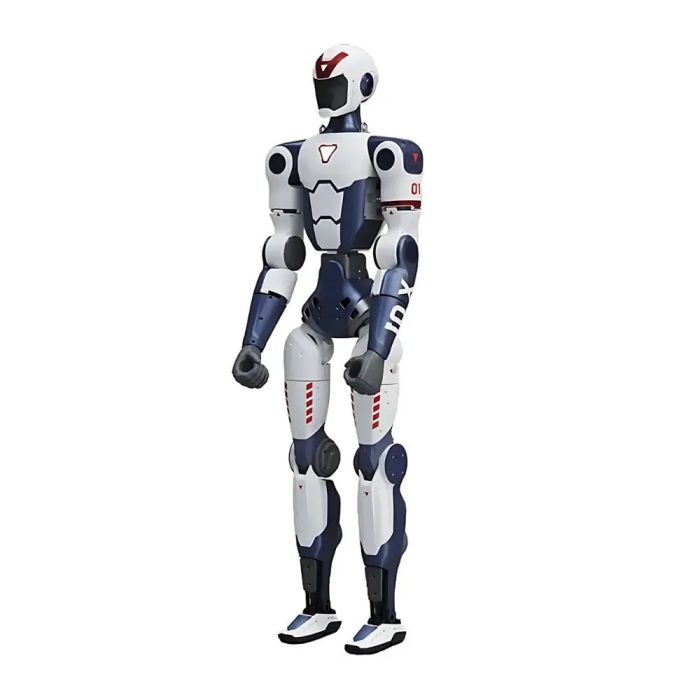
Unitree R1 Edu Standard Humanoid Robot (R1 EDU U1)
In stock
- BRAND:
- UNITREE ROBOTICS
- MODEL:
- R1 EDU STANDARD
- PART #:
- R1 EDU U1
- ORIGIN:
- China
- Warranty:
- 12 MONTHS
- AVAILABILITY:
- PRE-ORDER
- SKU:
- Unitree-Robotics-R1-EDU-U1
The R1 line is positioned as a compact, lightweight humanoid intended to lower the barrier to entry for institutions and teams that need a real robot—rather than a simulation-only workflow—to validate perception, locomotion, and manipulation algorithms. On Unitree’s own product page, the R1 is presented as an “ultra-lightweight” humanoid with “fully open control interfaces for joints and sensors” and support for mainstream simulation platforms, emphasizing continuity between simulation and hardware deployment. While Unitree offers multiple R1 variants (including R1 AIR and R1), the R1 EDU tier is marketed as the development-focused option, typically associated with expanded customization, secondary development support, and configurable compute/perception modules. In reseller catalogs, the “R1 EDU Standard (U1)” label commonly denotes a baseline educational bundle that balances capability (e.g., multi-DOF body, binocular vision, optional high-performance compute) with lower integration complexity for classrooms and labs.
Background: The Case for an Entry-Level Research EDU Variant
Unitree Robotics designed the R1 EDU Standard specifically to serve the large, underserved market segment of university programs, community colleges, individual researchers, and small STEM institutions that need genuine programming access to a bipedal humanoid but cannot justify the $15,000 to $35,000 investment of the Smart and Pro EDU tiers.
Before the R1 EDU launched, researchers wanting a programmable bipedal humanoid faced a practical market gap: consumer robots like the R1 Basic and R1 Air offered no programming access; the Unitree G1 EDU with full SDK was priced at $43,500 to $74,000; and competing platforms from AgiBot, Figure, and Boston Dynamics were exclusively enterprise-priced. BotInfo.ai identifies this gap explicitly: "Unitree targets the underserved $10–20K university lab segment that previously had no viable options between $2K educational arms and $45K+ research humanoids."
The R1 EDU Standard bridges this gap with a 40-TOPS Jetson Orin, full SDK, and ROS 2 compatibility at the $10,000 to $12,000 price tier — enabling research programs that previously had no budget-compatible humanoid option to enter practical bipedal robot research. For multi-robot swarm research, the U1's price point is even more compelling: BotInfo.ai notes that "3-4 R1s can be purchased for the price of a single G1," enabling fleet-scale experiments that would be economically impossible at higher price tiers.
The Robot Report's coverage of the R1 launch (July 2025) confirmed the educational positioning directly: "We will have an EDU (educational) version that allows purchasers to perform secondary development, and it can use ROS 2," Unitree told The Robot Report. "Autonomy is achievable but requires secondary development."
Design and Physical Features
Compact Form Factor: 121 cm, 25 kg, Composite Frame
The R1 EDU Standard uses the same physical frame as all R1 variants — 121 centimeters tall, approximately 25 kilograms (29 kg with battery in some configurations), dimensions of 1230 x 357 x 190 mm. The lightweight composite material construction enables single-operator transport, operation in standard classroom and laboratory environments, and reduced hardware consequence when locomotion policy research causes falls or unexpected contact.
OpenELAB confirms: "The public R1 family information lists 1230 x 357 x 190 mm and about 29 kg with battery for the R1 EDU family." The ultra-lightweight, fully customizable exterior includes interchangeable finishes enabling personalization for different deployment contexts.
24 Degrees of Freedom Architecture
The R1 EDU Standard's 24 degrees of freedom are distributed across the core locomotion and basic interaction subsystems:
Arms: Five degrees of freedom per arm (bilateral, 10 total) — covering shoulder flexion-extension, shoulder abduction-adduction, elbow flexion, and wrist rotations in both axes. The 5-DOF arm is the baseline configuration for the lower EDU tier, compared to the 7-DOF arms of the EDU Pro variants.
Legs: Six degrees of freedom per leg (bilateral, 12 total) — covering the full hip-knee-ankle articulation required for stable bipedal locomotion, dynamic maneuvers (cartwheels, handstands, running at 9 km/h), and autonomous fall recovery.
Waist: Two degrees of freedom (yaw ±150°, roll ±30°) enabling torso rotation and lean for extended arm reach and whole-body motion coordination.
The 24-DOF count is consistent with Ronomics' specification listing ("R1 Standard: 24 DOF, 6 per leg, 5 per arm, 2 waist") and 3Digital's R1 Basic description ("24 total degrees of freedom"). The U1 EDU Standard uses this same core body configuration without the additional head and hand DOF that the higher EDU tiers add.
Note on head DOF: OpenELAB's U1 listing mentions binocular camera support for the R1 EDU family without specifying additional head movement DOF beyond the base body configuration. Buyers requiring the enhanced dual-DOF head mobility should confirm this at the time of purchase or consider the EDU Smart (U2) tier, which adds head mobility as a standard feature.
Binocular Stereo Cameras
The R1 EDU Standard includes binocular stereo cameras — providing depth perception that the monocular camera of the R1 Air lacks. Binocular stereo vision is the baseline perception requirement for most robotics research applications: depth-from-stereo enables 3D workspace mapping, object detection at known distances, and the visual grounding needed for navigation and basic manipulation research. The depth perception provided by binocular cameras makes the U1 significantly more research-capable for perception-related work than the monocular R1 Air, despite the lower cost.
Technology and Specifications
R1 EDU Standard (U1) Full Specifications
| Specification | Value |
|---|---|
| Height | ~121 cm (1.21 m) |
| Weight | ~25 to 29 kg |
| Total Degrees of Freedom | 24 |
| Arm DOF | 5 per arm (bilateral, 10 total) |
| Leg DOF | 6 per leg (bilateral, 12 total) |
| Waist DOF | 2 (±150° yaw, ±30° roll) |
| Head DOF | Binocular camera; head mobility TBC per configuration |
| Dexterous Hands | Not included (standard) |
| Main Compute | 8-core high-performance CPU |
| AI Compute Module | NVIDIA Jetson Orin (40 TOPS) |
| Camera | Binocular stereo |
| Audio | 4-microphone array, stereo speakers |
| Connectivity | WiFi 6, Bluetooth 5.2 |
| Battery | Quick-swappable, ~1 hour |
| AI Framework | UnifoLM large multimodal model (onboard) |
| OTA Updates | Yes |
| Secondary Development | Full SDK + ROS 2 |
| Simulation Support | Mainstream simulation platforms |
| Warranty (standard markets) | 12 months |
| Warranty (EU/UK statutory) | 24 months (at OpenELAB) |
| Key Distributors | RobotShop (global); OpenELAB Technology (global, 12mo warranty) |
| Delivery Timeline | Q2 2026 (phased from April 2026) |
NVIDIA Jetson Orin (40 TOPS): Entry-Level EDU AI Compute
The NVIDIA Jetson Orin module in the R1 EDU Standard provides 40 TOPS of dedicated AI compute — the Jetson Orin NX 8GB or equivalent configuration providing GPU-accelerated neural network inference for locomotion AI, visual perception, and the onboard UnifoLM multimodal model. This is the 40-TOPS baseline of the Jetson Orin family, compared to the 100-TOPS configuration used in the EDU Smart (U2) through EDU Pro (U3-U6) variants.
For entry-level research applications — locomotion controller development, basic visual perception pipelines, introductory reinforcement learning experiments, and UnifoLM multimodal AI interaction — the 40-TOPS Jetson Orin is sufficient. Robozaps' review confirms: "The R1 EDU can optionally add an NVIDIA Jetson Orin module (40-100 TOPS) for researchers and developers needing more computing power" — with the U1's 40-TOPS version the entry tier of the Jetson Orin range.
For research programs planning to run large VLA (Vision-Language-Action) models, train on-device with large neural network architectures, or develop manipulation policies requiring high-rate visual processing, the EDU Smart (U2, 100 TOPS) or EDU Pro (U3-U6, 100 TOPS) variants provide the additional compute headroom the U1 does not.
Full SDK: Linux-Based Open Development Environment
The R1 EDU Standard's secondary development capability is its primary differentiating feature from the consumer R1 and R1 Basic. OpenELAB confirms: "R1 EDU edition supports secondary development. Unitree's public R1 family information states that secondary development is supported for the R1 EDU edition." This means the U1 provides:
Linux-based open SDK: A development environment on the robot's Intel/ARM compute platform for writing, deploying, and testing custom robot control code without being limited to Unitree's pre-packaged behaviors.
Joint and sensor interfaces: Full programmatic access to joint motor commands (position, velocity, torque), IMU data, camera data streams, force/torque sensor readings from joint encoders, and microphone audio — the complete sensor-actuator interface needed for custom locomotion controller development.
Python and C++ APIs: Programming language interfaces that match the standard tools used in academic robotics research and AI development, enabling students and researchers to use familiar tools without custom language learning overhead.
ROS 2 support: Robot Operating System 2 integration enabling connection to the full ROS 2 research ecosystem — navigation (Nav2), manipulation planning (MoveIt2), visualization (RViz2), simulation interfaces, and the extensive library of published ROS 2 packages for robotics research.
Simulation platform support: Unitree confirms support for "mainstream simulation platforms" — including NVIDIA Isaac Sim and standard ROS 2 simulation tools — enabling sim-to-real research workflows where algorithms are developed and validated in simulation before deployment on the physical U1.
UnifoLM Multimodal AI: Onboard Voice and Vision
The R1 EDU Standard runs Unitree's UnifoLM large multimodal model onboard, enabling voice command recognition, image-based task instruction, gesture recognition, and local reinforcement learning policy execution without cloud connectivity. OpenELAB notes the "integrated multimodal interaction direction with voice and image model capability highlighted by Unitree" for the R1 EDU family.
The Jetson Orin's CUDA support enables the UnifoLM inference to run at real-time speeds without competing with the 8-core CPU's control loop responsibilities, maintaining the response quality that voice and image interaction requires.
Applications and Use Cases
Undergraduate and Graduate Robotics Curriculum
The R1 EDU Standard's $10,000 to $12,000 price point, full ROS 2 compatibility, and SDK access make it the most practical platform for university robotics curricula where equipment budgets are constrained. A single U1 within a department's standard equipment budget enables hands-on ROS 2 development labs, locomotion algorithm exercises, and visual perception projects on a real bipedal humanoid — experiences that simulation alone cannot provide and that $43,500 G1 EDU configurations cannot fit within typical departmental procurement limits.
Ronomics' user community feedback confirms the educational utility: "Perfect for teaching ROS 2 concepts on a real humanoid platform. Affordable for our whole class set." This assessment captures the U1's primary value for educational programs — the ability to purchase multiple units within a course or lab budget rather than a single expensive platform shared across many students.
Entry-Level Bipedal Locomotion Research
For research programs beginning to work with bipedal humanoid platforms, the U1 provides the physical hardware for developing, deploying, and testing locomotion algorithms — walking controllers, balance recovery policies, dynamic gait optimization — at the lowest price point in Unitree's SDK-enabled lineup. The 24-DOF body provides the full leg articulation (6 DOF per leg) needed for dynamic bipedal locomotion research, and the SDK's joint-level access enables direct deployment of custom locomotion policies.
Sim-to-Real Transfer Experiments
The U1's simulation platform support, SDK, and ROS 2 compatibility create a complete sim-to-real workflow: policies developed in NVIDIA Isaac Sim or Gazebo using the R1's URDF model can be transferred to the physical U1 hardware for real-world validation. This workflow is the backbone of modern reinforcement learning-based locomotion research, and the U1 provides the necessary hardware component at a price that enables multiple units for parallel physical experiments.
AI and Embodied Intelligence Teaching Labs
For AI courses covering embodied intelligence, reinforcement learning, and physical AI — increasingly common in computer science and AI programs at universities — the U1 provides the humanoid robot substrate for demonstrating and experimenting with the concepts. The UnifoLM's voice and image interaction capabilities enable demonstrations of multimodal AI in an embodied context, while the Jetson Orin's CUDA support enables on-device neural network deployment exercises.
Multi-Robot and Swarm Research
BotInfo.ai notes: "For multi-robot swarm research, the R1's lightweight 25kg frame and 40/100 TOPS computing make it ideal for fleet deployments — 3-4 R1s can be purchased for the price of a single G1." At $10,000 to $12,000 per unit, a research grant budget that would buy a single Unitree G1 EDU ($43,500) can instead purchase three to four U1 units for fleet locomotion research, multi-robot coordination studies, or parallel policy evaluation experiments.
Individual Developer and Startup Prototyping
For individual AI developers, ML researchers, and robotics startup teams who need to prototype humanoid robot applications, the U1's $10,000 to $12,000 price falls within the range of equipment that can be purchased from a startup pre-seed budget or a personal research investment without requiring institutional funding. The full SDK access enables custom application prototyping on a real hardware platform before committing to larger procurement programs.
Advantages and Benefits
Most Affordable Humanoid Robot with Full SDK and ROS 2 Access: At $10,000 to $12,000, the R1 EDU Standard is confirmed as "the most affordable humanoid with ROS 2 support that you can actually buy today" by BotInfo.ai — undercutting the next available alternative (the Unitree G1 EDU at $43,500) by approximately $30,000 to $55,000.
Enables Multi-Robot Lab Setups at Single-Robot Competitor Price: The $10,000 to $12,000 U1 price allows research programs to purchase three to four units within the budget of a single high-tier humanoid, enabling fleet experiments, multi-robot coordination research, and per-student access models that are economically impossible at higher price points.
Jetson Orin (40 TOPS) for On-Device AI Development: Even the entry-level 40-TOPS Jetson Orin provides GPU-accelerated neural network inference that the base 8-core CPU alone cannot deliver at real-time speeds for visual AI models — enabling researchers to develop and deploy learning-based locomotion policies on-device rather than relying on off-robot compute.
Complete ROS 2 Ecosystem Access for Standard Research Workflows: Full ROS 2 compatibility enables the U1 to integrate directly with the standard academic robotics software stack — Nav2, MoveIt2, RViz2, rosbag2, and hundreds of published ROS 2 packages — without requiring custom communication layer development.
12-Month Warranty (24-Month EU/UK) for Institutional Confidence: OpenELAB's warranty terms provide institutional support coverage comparable to other research equipment categories, supporting procurement within standard lab equipment budgeting frameworks.
OTA Updates for Post-Delivery Capability Improvement: Over-the-air firmware updates continuously improve the U1's locomotion algorithms and AI capabilities after delivery, providing ongoing value improvement across a multi-year curriculum or research program lifecycle.
Comparison: U1 vs. R1 Basic vs. EDU Smart (U2)
| Feature | R1 Basic ($5,900) | R1 EDU Standard U1 ($10–12K) | R1 EDU Smart U2 ($15–19K) |
|---|---|---|---|
| Total DOF | 26 | 24 | ~26+ |
| SDK / ROS 2 | No (closed system) | Yes (full SDK + ROS 2) | Yes (full SDK + ROS 2) |
| AI Compute | 8-core CPU only | Jetson Orin 40 TOPS | Jetson Orin 100 TOPS |
| Programming | Remote control only | Full secondary development | Full secondary development |
| Dexterous Hands | No | No | No |
| Estimated Price | $5,900–$8,990 | $10,000–$12,000 | $15,000–$19,000 |
| Best For | Demonstrations, consumer | Entry-level research, education | Research requiring 100 TOPS |
Frequently Asked Questions (FAQ)
What is the Unitree R1 EDU Standard (U1)? The Unitree R1 EDU Standard (U1) is the entry-level research and education configuration of the Unitree R1 humanoid robot, providing the most affordable access to full SDK and ROS 2 programming capabilities on a capable bipedal humanoid platform. Priced at approximately $10,000 to $12,000, it stands 121 centimeters tall at 25 kilograms, features 24 degrees of freedom, an NVIDIA Jetson Orin (40 TOPS) AI compute module alongside an 8-core CPU, binocular stereo cameras, WiFi 6 and Bluetooth 5.2, and a full Linux-based open SDK with ROS 2 support. It is designed for AI robotics study, embodied intelligence learning, and humanoid development workflows.
What is the difference between the R1 Basic and the R1 EDU Standard (U1)? The R1 Basic ($5,900 to $8,990) is a closed system with no SDK, no ROS 2 support, and no secondary development capability — it is remote-controlled only, suitable for demonstrations but not programming. The R1 EDU Standard (U1) at $10,000 to $12,000 adds a full Linux-based SDK, Python and C++ APIs, ROS 2 support through Unitree's SDK2 framework, a NVIDIA Jetson Orin (40 TOPS) AI compute module, and full secondary development access enabling custom locomotion algorithms, AI policy deployment, and simulation-to-real workflows. For any research or development application requiring programming, the EDU Standard is the minimum viable configuration.
What can I do with the R1 EDU Standard (U1) that I cannot do with the R1 Basic? With the R1 EDU Standard, you can: write and deploy custom locomotion control algorithms in Python or C++; integrate the robot with the ROS 2 ecosystem for navigation, manipulation planning, and visualization; run GPU-accelerated neural network models on the NVIDIA Jetson Orin (40 TOPS) on-device; develop and test reinforcement learning locomotion policies; execute sim-to-real workflows where policies trained in NVIDIA Isaac Sim or Gazebo are deployed to the physical robot; directly access all joint motors, IMUs, cameras, and sensor data through the SDK; and record multi-modal research datasets including joint state, camera, and IMU data using rosbag2. None of these are possible on the closed R1 Basic.
Is the 40-TOPS Jetson Orin sufficient for humanoid research, or should I choose the EDU Smart (U2)? The 40-TOPS Jetson Orin in the U1 is sufficient for introductory locomotion research, ROS 2 curriculum development, visual perception pipelines with moderate model sizes, UnifoLM multimodal AI interaction, and multi-robot fleet experiments where per-unit compute cost matters more than maximum per-unit compute. For research programs planning to run large vision-language-action models on-device, train with large neural network architectures at real-time speeds, or develop manipulation policies with high-rate visual processing requirements, the EDU Smart (U2, 100 TOPS) or EDU Pro (U3-U6, 100 TOPS) variants provide necessary additional headroom at a $3,000 to $7,000 premium.
Summary
The Unitree R1 EDU Standard (R1 EDU U1) establishes the most accessible entry point in the programmable humanoid robot market, providing 24 degrees of freedom, NVIDIA Jetson Orin (40 TOPS) GPU-accelerated AI compute, binocular stereo cameras, WiFi 6, and complete open SDK with ROS 2 support at an estimated $10,000 to $12,000 — approximately $30,000 to $55,000 less than the Unitree G1 EDU and the only alternative providing ROS 2 access on a capable bipedal humanoid within that price range. For university programs teaching ROS 2 on real humanoid hardware, individual researchers entering bipedal locomotion and embodied AI development, multi-robot fleet experiments requiring affordable per-unit cost, and startup teams prototyping humanoid robot applications before institutional funding, the R1 EDU Standard provides the research instrument capability that the closed R1 Basic cannot offer — at the minimum price at which genuine bipedal humanoid research becomes practically accessible.