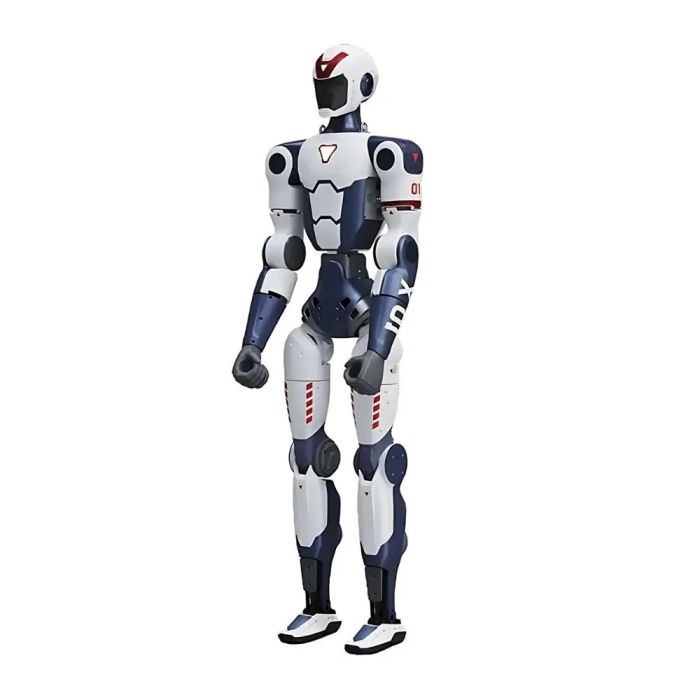
Unitree R1 Edu Pro B Humanoid Robot (R1 EDU U4)
In stock
- BRAND:
- UNITREE ROBOTICS
- MODEL:
- R1 EDU PRO B
- PART #:
- R1 EDU U4
- ORIGIN:
- China
- Warranty:
- 12 MONTHS
- AVAILABILITY:
- PRE-ORDER
- SKU:
- Unitree-Robotics-R1-EDU-U4
The Unitree R1 EDU Pro B, formally designated the R1 EDU U4, is a research-grade configuration within Unitree Robotics' R1 EDU humanoid lineup. Standing approximately 121 centimeters tall and weighing around 25 kilograms, the U4 features up to 40 degrees of freedom, the NVIDIA Jetson Orin (100 TOPS) AI compute module, WiFi 6, Bluetooth 5.2, binocular stereo cameras, and a full open SDK with ROS 2 support. Its defining hardware characteristic the feature that differentiates it from the U3 (R1 EDU Pro A) within the same EDU Pro tier — is that its Dex3-1 dexterous hands are equipped with 33 touch sensors, providing tactile sensing capability that the U3's non-sensing Dex3-1 configuration lacks.
The R1 EDU Pro B is listed at RobotShop (robotshop.com) for global delivery with Q2 2026 phased delivery. 3Digital (3digital.tech), an authorized Italian distributor, explicitly documents the U4's defining characteristic: "The R1 EDU Pro B (U4) is similar to the R1 EDU Pro A (U3), but the hands are equipped with 33 touch sensors." This single hardware specification — 33 tactile contact points distributed across the hand — is what makes the U4 the appropriate choice for research programs requiring contact-aware manipulation where the robot must sense not only whether it is touching an object but precisely where and with how much localized pressure.
Background: Tactile Sensing and the R1 EDU Pro Tier
The inclusion of 33 touch sensors in the Dex3-1 hands of the R1 EDU Pro B reflects a specific research need that sits between two adjacent configurations in the R1 EDU lineup: the kinematic-only Dex3-1 hands of the U3, and the five-finger BrainCo Revo 2 hands of the U5. Understanding why tactile sensing matters — and when it matters more than five-finger dexterity — helps explain why the U4 exists as a distinct configuration.
Robotic grasping and manipulation research has long recognized two separable challenges: the kinematic challenge (can the robot's hand reach the right configuration around an object?) and the sensing challenge (can the robot detect whether its grasp is stable, whether the object is slipping, and whether the contact forces are appropriate for the object's fragility?). A robot can have perfect kinematic dexterity but still drop objects, crush fragile items, or fail grasp verification without tactile sensing; conversely, a robot can have rich tactile sensing but still be unable to execute grasp configurations outside its kinematic range.
The U3 addresses the kinematic challenge with a three-finger Dex3-1 configuration. The U4 adds contact sensing to the same three-finger architecture, enabling research on contact-aware grasping — where the robot uses finger contact pressure distribution to verify grasp stability, detect slip onset, and control grip force for fragile or deformable objects. The U5 and U6 address both challenges differently, moving to five-finger BrainCo Revo 2 hands (without tactile for U5, with tactile for U6) for research that requires the full human grasp taxonomy.
For research teams whose primary need is tactile contact sensing alongside the Dex3-1's proven three-finger manipulation capability, the U4 is the appropriate tier — offering tactile sensing at the EDU Pro price point without the additional cost of the five-finger hand transition.
Design and Physical Features
Shared Physical Frame with the R1 EDU Pro Family
The R1 EDU Pro B shares the standard R1 physical platform 121 centimeters tall, 25 kilograms, with body dimensions of 1230 x 357 x 190 mm. This compact, ultra-lightweight composite frame is the same across all R1 variants. The compact form factor enables single-operator transport, standard laboratory operation without floor-level workspace requirements, and reduced hardware consequence when locomotion or manipulation policy exploration causes falls or unexpected contact during research cycles.
40 Degrees of Freedom: Full-Body Kinematic Architecture
The R1 EDU Pro B offers up to 40 total degrees of freedom, distributed across the same kinematic architecture as the U3:
Arms: Seven degrees of freedom per arm (bilateral) enabling full shoulder-to-wrist articulation for any reachable hand orientation within the arm's workspace.
Legs: Six degrees of freedom per leg (bilateral) covering hip-knee-ankle articulation for stable bipedal locomotion, dynamic athletic maneuvers including running at 9 km/h, cartwheels, and handstands, and autonomous fall recovery.
Waist: Two degrees of freedom (yaw ±150°, roll ±30°) enabling torso rotation and lean for whole-body motion coordination, extended reach, and balance adjustment during manipulation.
Head: Two degrees of freedom (pan and tilt) for active visual tracking of manipulation targets, maintaining camera fixation on grasped objects during bimanual tasks, and natural orientation during human interaction.
Hands: The Dex3-1 three-finger hands add hand DOF to the 26-DOF body configuration, reaching the "up to 40 DOF" total that includes both body and hand degrees of freedom.
Dex3-1 Hands with 33 Touch Sensors
The Dex3-1 is Unitree's three-finger force-controlled robotic hand. In standard configurations across some EDU variants, the Dex3-1 provides kinematic three-finger manipulation without distributed tactile sensing. The R1 EDU Pro B (U4) specifically adds 33 touch sensors to this hand configuration — a tactile array distributed across the finger contact surfaces to provide spatial contact pressure mapping during manipulation tasks.
The 33-sensor count provides enough spatial resolution to detect the contact patch shape during grasping — identifying which finger surfaces are in contact with an object, how the contact pressure is distributed across each contact zone, and whether the contact distribution is changing (indicating object motion or grasp instability). This information enables contact-aware grasping control strategies including:
Grip force regulation: Adjusting finger closure force based on sensed contact pressure rather than commanded position, preventing crushing of deformable or fragile objects.
Slip detection: Monitoring changes in the contact pressure distribution pattern that indicate the onset of object sliding before a full drop occurs, triggering grip tightening or re-grasp strategies.
Grasp quality assessment: Evaluating whether the sensed contact pattern indicates a stable grasp (contact distributed across multiple finger pads) or an unstable grasp (contact concentrated at fingertip edges), guiding grasp re-formation if needed.
Contact-driven task verification: Detecting task completion through the presence or absence of expected contact patterns — confirming object handover, fixture engagement, or surface contact in assembly tasks.
The 33-sensor Dex3-1 configuration in the U4 makes it the appropriate research platform for any manipulation research requiring spatial contact feedback alongside the three-finger architecture.
Technology and Specifications
R1 EDU Pro B (U4) Full Specifications
| Specification | Value |
|---|---|
| Height | ~121 cm |
| Weight | ~25 kg |
| Total Degrees of Freedom | Up to 40 |
| Arm DOF | 7 per arm (bilateral) |
| Leg DOF | 6 per leg (bilateral) |
| Waist DOF | 2 (±150° yaw, ±30° roll) |
| Head DOF | 2 (pan and tilt) |
| Hand Configuration | Dex3-1 (3-finger) with 33 touch sensors |
| Touch Sensor Count | 33 per hand |
| Main Compute | 8-core high-performance CPU |
| AI Compute Module | NVIDIA Jetson Orin (100 TOPS) |
| Cameras | Binocular stereo |
| Audio | 4-microphone array, stereo speakers |
| Connectivity | WiFi 6, Bluetooth 5.2 |
| Battery | Quick-swappable, ~1 hour |
| AI Framework | UnifoLM large multimodal model (onboard) |
| OTA Updates | Yes |
| Secondary Development | Full SDK + ROS 2 |
| Primary Distributor | RobotShop (global); 3Digital (Italy/EU) |
| Delivery Timeline | Q2 2026 (phased from April 2026) |
| Best For | Tactile sensing, contact-aware manipulation research |
NVIDIA Jetson Orin (100 TOPS): GPU-Accelerated Tactile AI
The NVIDIA Jetson Orin's 100 TOPS AI compute is particularly relevant to the U4's tactile sensing research context. Tactile sensor data processing — interpreting contact pressure distributions, detecting slip onset from sensor array patterns, and feeding tactile feedback into manipulation policy networks — is computationally demanding when done with neural network-based perception models rather than simple threshold-based rules.
Research on learning-based tactile manipulation — where neural networks are trained to predict grasp stability, object properties, or task completion from tactile sensor readings — requires GPU-accelerated inference to run at the control loop frequencies necessary for reactive manipulation. The Jetson Orin's CUDA support enables tactile perception networks to be deployed on-device in the U4, processing the 33-sensor data stream through learned models at real-time speeds.
For simulation-to-real research on tactile grasping, the Jetson Orin also supports NVIDIA Isaac Sim integration through the R1 EDU's simulation interfaces — enabling tactile manipulation policies trained in simulation (using simulated contact sensors) to be transferred and evaluated on the physical U4 hardware.
SDK and ROS 2 for Tactile Research Workflows
The R1 EDU Pro B's full secondary development SDK provides programmatic access to the Dex3-1 hand's 33 touch sensor data stream alongside the standard joint control, camera, and IMU interfaces. For manipulation researchers, the specific SDK capabilities of greatest relevance to tactile research include:
Tactile data acquisition API: Real-time access to the 33-sensor contact pressure readings at research-appropriate sampling rates, enabling integration with custom tactile processing pipelines.
Fingertip force control: APIs for commanding the Dex3-1's finger closure with force feedback from the tactile sensors, enabling soft-grip control strategies for fragile objects.
Hand-arm coordination interface: Coordinating arm trajectory (from the 7-DOF arm) with hand grasp formation and tactile sensor feedback in a unified whole-body control loop through the SDK.
ROS 2 topic publishing: Standard ROS 2 message publishing for tactile sensor readings, enabling direct integration with ROS 2 manipulation packages (MoveIt2 sensor feedback plugins), visualization (RViz2 point cloud renderers for contact visualization), and research data recording (rosbag2 for synchronized multi-modal research datasets).
Applications and Use Cases
Tactile Grasp Policy Learning
The primary application driving the U4's 33-touch-sensor Dex3-1 configuration is tactile grasp policy learning — research on training manipulation policies that use tactile sensor readings as input alongside visual observations. Recent advances in tactile manipulation research have demonstrated that policies that include tactile feedback generalize significantly better across object variations (different masses, surface textures, and shapes) than vision-only policies.
The U4 provides the hardware substrate for this research on a bipedal humanoid platform — enabling studies not only of manipulation with tactile feedback in isolation, but of whole-body coordination where bipedal locomotion and tactile-feedback manipulation occur simultaneously.
Fragile and Deformable Object Handling
Research on grasping fragile objects (glass containers, pharmaceutical packaging, electronic components) and deformable objects (soft pouches, fruit, packaging bags) requires tactile sensing to prevent over-pressuring objects during grasping. The U4's 33 touch sensors enable grip force regulation strategies — where the robot adjusts its grip based on sensed contact pressure rather than just commanded position — that are not achievable without distributed contact sensing.
Slip Detection and Reactive Grasping
Detecting object slip onset — the early-warning change in contact pressure distribution that precedes a full drop event — is a fundamental capability for manipulation reliability. The U4's tactile array enables the development and testing of slip detection algorithms and reactive re-grasping strategies, with the physical R1 platform providing real-world testing grounds that simulation cannot fully replicate.
Tactile Exploration and Object Property Estimation
Active tactile exploration — deliberately moving the robot's hand across an object's surface to estimate its shape, texture, or material properties — is a research area with applications in household robotics, medical diagnostics, and material inspection. The U4's 33-sensor array provides the spatial resolution needed for tactile shape reconstruction from exploratory finger movements.
Whole-Body Human-Robot Physical Interaction
Physical interaction between the robot's hands and a human — handshakes, object handovers, collaborative manipulation — benefits from tactile sensing for safety and interaction quality. The U4's touch sensors detect the force distribution during physical contact with a human hand, enabling control strategies that regulate contact forces for safe and natural-feeling physical interaction.
Comparison: U4 vs. U3 vs. U5 in the R1 EDU Pro Tier
| Feature | R1 EDU Pro A (U3) | R1 EDU Pro B (U4) | R1 EDU Pro C (U5) |
|---|---|---|---|
| Hand Configuration | Dex3-1 (3-finger, no tactile) | Dex3-1 (3-finger, 33 touch sensors) | BrainCo Revo 2 Basic (5-finger, no tactile) |
| Total DOF | Up to 40 | Up to 40 | 38 |
| Tactile Sensing | No | Yes (33 sensors per hand) | No |
| Five-Finger Dexterity | No | No | Yes |
| AI Compute | Jetson Orin (100 TOPS) | Jetson Orin (100 TOPS) | Jetson Orin (100 TOPS) |
| Full SDK + ROS 2 | Yes | Yes | Yes |
| Best For | Three-finger manipulation, max DOF | Tactile-sensing manipulation research | Five-finger bimanual manipulation |
The U4 occupies the tactile sensing niche within the EDU Pro tier. Research programs that need distributed contact sensing from the robot's hands but do not require five-finger kinematics should choose the U4. Programs that need five-finger dexterity without tactile sensing should choose the U5; programs that need both five-finger dexterity and tactile sensing should evaluate the U6 (BrainCo Revo 2 Touch, 38 DOF, which provides tactile sensing on five-finger hands).
Advantages and Benefits
Tactile Contact Sensing for Research Applications That Require It: The 33 touch sensors in the U4's Dex3-1 hands provide spatial contact pressure mapping that enables contact-aware grasping, slip detection, grip force regulation, and tactile exploration — capabilities that cannot be achieved with the kinematic-only U3 hands.
Same Maximum DOF as U3 (Up to 40): Adding 33 touch sensors to the U3's Dex3-1 hands does not reduce the DOF count — the U4 maintains the same up to 40-DOF kinematic architecture as the U3, combining maximum kinematic range with tactile sensing capability.
NVIDIA Jetson Orin for GPU-Accelerated Tactile AI: The 100-TOPS Jetson Orin enables neural network-based tactile perception models to run on-device at real-time speeds, enabling learning-based approaches to tactile grasp quality assessment, slip detection, and object property estimation that threshold-based rules cannot match.
Full SDK and ROS 2 Tactile Data Access: Programmatic access to the 33-sensor data stream through the SDK and ROS 2, including force control APIs and sensor message publishing, enables integration with the full ROS 2 manipulation research ecosystem.
Compact 25 kg Research Platform: The lightweight composite frame enables research with reduced hardware consequence compared to heavier platforms — important when developing contact-based manipulation policies that involve unexpected contact events during exploration.
WiFi 6 for High-Bandwidth Tactile Data Logging: WiFi 6's higher bandwidth is particularly relevant for research applications that involve logging high-rate tactile sensor streams alongside video and joint state data for multi-modal research datasets.
Frequently Asked Questions (FAQ)
What is the Unitree R1 EDU Pro B (U4)? The Unitree R1 EDU Pro B (U4) is a research-grade EDU configuration of the Unitree R1 humanoid robot, standing approximately 121 centimeters tall at 25 kilograms with up to 40 degrees of freedom. Its defining feature is the inclusion of Dex3-1 three-finger dexterous hands equipped with 33 touch sensors per hand — providing spatial contact pressure mapping capability that the kinematic-only Dex3-1 configuration of the U3 lacks. It includes NVIDIA Jetson Orin (100 TOPS) alongside an 8-core CPU, binocular stereo cameras, WiFi 6 and Bluetooth 5.2, a 4-microphone array, and a full Linux-based SDK with ROS 2 support for secondary development. Estimated price is $20,000 to $35,000.
How does the U4 differ from the U3 (R1 EDU Pro A)? The R1 EDU Pro A (U3) and R1 EDU Pro B (U4) share the same physical frame, up-to-40-DOF kinematic architecture, Dex3-1 three-finger hands, NVIDIA Jetson Orin (100 TOPS), and full SDK configuration. The single differentiating feature is that the U4's Dex3-1 hands include 33 touch sensors per hand, while the U3's Dex3-1 hands do not include tactile sensing. For research programs requiring contact pressure distribution mapping, slip detection, grip force regulation from tactile feedback, or tactile exploration, the U4 is the appropriate choice. For programs where three-finger kinematic manipulation without tactile sensing covers the research requirements, the U3 provides equivalent capability at comparable pricing.
What research applications benefit specifically from the U4's 33 touch sensors? The 33-sensor tactile array in the U4's Dex3-1 hands enables research on: tactile grasp quality assessment (evaluating grasp stability from contact pressure distribution), slip detection and reactive regrasping (detecting slip onset before a full drop), grip force regulation for fragile and deformable objects, tactile exploration for object shape and material property estimation, learning-based tactile manipulation policies (training neural networks on tactile sensor data), and physical human-robot interaction safety (regulating contact forces during handshakes and object handovers). These research areas all require spatial contact sensing that kinematic-only configurations cannot provide.
Where can I buy the Unitree R1 EDU Pro B (U4)? The R1 EDU Pro B (U4) is listed at RobotShop (robotshop.com/products/unitree-r1-edu-pro-b-u4-humanoid-robot) for global Q2 2026 delivery. 3Digital (3digital.tech) stocks the U4 with supply times noted around August 2026 and free express shipping for orders over €499. ToborLife (toborlife.ai) offers North American buyers free shipping with 100 percent refundable deposits. OpenELAB Technology (openelab.io) provides a 12-month warranty (24-month EU/UK). BotInfo.ai supports institutional procurement with purchase orders and grant documentation. Confirm the U4 (Pro B, 33 touch sensors) configuration specifically when ordering, to distinguish from the U3 (no tactile) and U5 (five-finger hands).
Does the U4's tactile sensing data stream integrate with ROS 2? Yes. The R1 EDU Pro B (U4) provides full ROS 2 support through Unitree's SDK2 framework, with the tactile sensor data stream available for publication as ROS 2 messages. This enables integration with ROS 2 manipulation visualization tools (RViz2), data recording infrastructure (rosbag2 for synchronized multi-modal dataset logging), and custom tactile perception packages in the ROS 2 ecosystem. The Jetson Orin's CUDA support enables GPU-accelerated neural network-based tactile processing to run on-device alongside the ROS 2 control and perception stack.
Summary
The Unitree R1 EDU Pro B (R1 EDU U4) fills the specific research niche of tactile-sensing three-finger manipulation on a compact, affordable bipedal humanoid — combining up to 40 degrees of freedom, Dex3-1 hands with 33 touch sensors per hand enabling spatial contact pressure mapping, NVIDIA Jetson Orin (100 TOPS) for GPU-accelerated tactile AI model deployment, and a full open SDK with ROS 2 for research development, all within the R1's 121-centimeter, 25-kilogram portable platform at an estimated $20,000 to $35,000. For research teams studying contact-aware grasping, slip detection, grip force regulation, tactile manipulation policy learning, or physical human-robot interaction, the U4's tactile layer on the Dex3-1 architecture provides a research substrate that the kinematic-only U3 cannot offer — at the same EDU Pro price tier. Available through RobotShop globally, 3Digital for European buyers, and ToborLife for North American buyers with free shipping, the U4 delivers Q2 2026 and represents one of the most research-specialized configurations in the R1 EDU family.