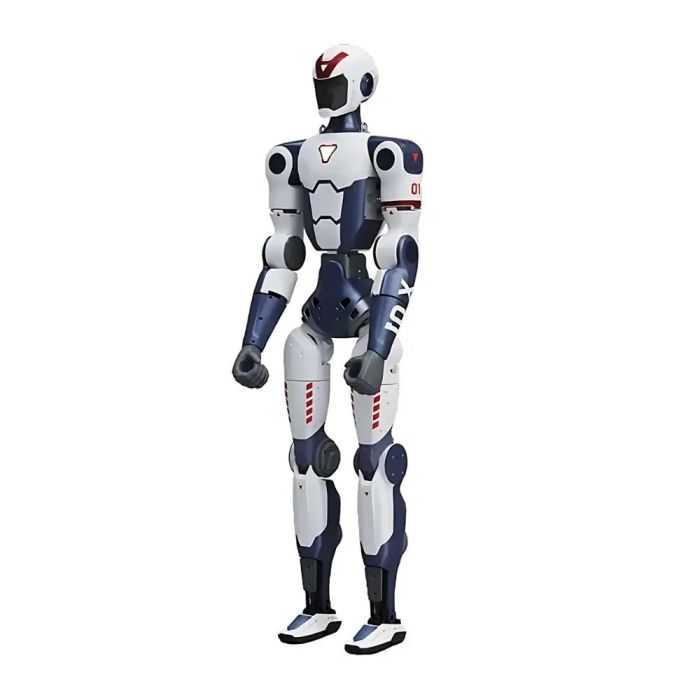
Unitree R1 Edu Pro C Humanoid Robot (R1 EDU U5)
In stock
- BRAND:
- UNITREE ROBOTICS
- MODEL:
- R1 EDU PRO C
- PART #:
- R1 EDU U5
- ORIGIN:
- China
- Warranty:
- 12 MONTHS
- AVAILABILITY:
- PRE-ORDER
- SKU:
- Unitree-Robotics-R1-EDU-U5
The R1 EDU Pro C includes the NVIDIA Jetson Orin (100 TOPS) AI compute module alongside the standard 8-core CPU, WiFi 6 and Bluetooth 5.2 connectivity, binocular stereo cameras, a 4-microphone array, stereo speakers, and a full open SDK with ROS 2 support for secondary development. It is listed at RobotShop (robotshop.com) and OpenELAB Technology (openelab.io/products/unitree-r1-edu-u5), with delivery beginning April 2026 as part of the R1 family's phased Q2 2026 global rollout. OpenELAB provides a 12-month warranty (or 24-month statutory guarantee for EU/UK buyers).
The inclusion of BrainCo Revo 2 Basic five-finger dexterous hands in the R1 EDU Pro C reflects a deliberate decision by Unitree to address the specific needs of manipulation researchers who require finger-level dexterity comparable to the human hand. BrainCo (BrainCo Inc.) is a Boston-based neurotechnology and robotics company known for its development of neural-controlled prosthetic hands. The Revo 2 is BrainCo's commercially released dexterous robotic hand, featuring five independently actuated fingers capable of the full complement of human grasping postures from pinch grasp through lateral grip through power grip.
The selection of BrainCo Revo 2 hands for the U5 configuration — rather than developing a proprietary Unitree dexterous hand — reflects an integration partnership that brings an established, commercially validated dexterous hand product into the R1 research ecosystem. BrainCo's prosthetic hand heritage means the Revo 2 is designed with human biomechanics in mind: finger lengths, joint ranges, and contact surface geometry are calibrated to interact with objects and environments designed for human hands.
OpenELAB's product description explicitly states the rationale for the U5's five-finger configuration: the bilateral BrainCo Revo 2 Basic hands provide "a stronger research fit for multi-finger manipulation, grasp planning, and hand-centered embodied AI workflows than the lower EDU variants without dexterous hands." The distinction from the U3 is noted as: "U5 uses five-finger Revo 2 Basic hands, while U3 and U4 use Dex3-1 three-finger hands" — establishing that the primary choice between U5 and U3/U4 is whether the research program requires five-finger dexterity or whether a high-quality three-finger gripper configuration is sufficient for the planned task set.
Design and Physical Features
Shared Platform: 121 cm, 25 kg, Compact Bipedal Frame
The R1 EDU Pro C uses the same physical frame as all R1 variants. At 121 centimeters and 25 kilograms with body dimensions of approximately 1230 x 357 x 190 mm, the robot is compact enough for single-operator transport and deployment in standard laboratory and classroom environments. The lightweight composite material construction that achieves this weight — compared to the G1's 35-kilogram metal frame — is a deliberate research-oriented design choice: lower body mass reduces the consequence of hardware incidents during locomotion and manipulation policy exploration, enables transport without equipment, and allows the robot to operate safely in shared spaces where a heavier, higher-inertia platform would pose greater physical risk.
38 Degrees of Freedom: Full-Body Kinematic Coverage
The R1 EDU Pro C's 38 degrees of freedom are distributed across the full body, with the DOF allocation reflecting the five-finger hand integration:
Arms: Seven degrees of freedom per arm (bilateral) provides the same 7-DOF kinematic architecture as premium industrial humanoid arms, enabling any target hand orientation within the arm workspace without kinematic singularities. This 7-DOF arm configuration is the prerequisite for reaching the hand into confined spaces, approaching grasp targets from arbitrary directions, and maintaining hand orientation during dynamic whole-body motion.
Legs: Six degrees of freedom per leg (bilateral) covering hip-knee-ankle articulation for stable bipedal locomotion including walking, running, stair navigation, and the dynamic athletic behaviors — cartwheels, handstands, running at 9 km/h — that characterize the R1's "Born for Sport" design mandate.
Waist: Two degrees of freedom (yaw ±150°, roll ±30°) enabling torso rotation and lateral lean for extended reach, whole-body balance coordination during manipulation, and task-relevant body orientation adjustment.
Head: Two degrees of freedom (pan and tilt) for active visual tracking of manipulation targets during bimanual task execution, maintaining camera fixation on objects of interest during grasping sequences, and natural head orientation during human-robot interaction.
Hands: The BrainCo Revo 2 Basic five-finger hands add bilateral hand DOF. The total 38-DOF count reflects the combination of body and hand degrees of freedom in the U5's specific configuration, compared to the up-to-40 DOF of the U3 where a different (three-finger) hand configuration changes the DOF distribution.
BrainCo Revo 2 Basic Five-Finger Dexterous Hands: Both Hands Included
The R1 EDU Pro C comes with two BrainCo Revo 2 Basic dexterous hands — both left and right — installed bilaterally. This bilateral installation is the specific detail that makes the U5 the appropriate configuration for bimanual manipulation research: studies of handover tasks, two-handed object assembly, bimanual coordination, and in-hand manipulation all require both hands to be dexterous simultaneously. Providing only one dexterous hand would limit research to unilateral manipulation, which is a substantially smaller research area.
The BrainCo Revo 2 Basic's five-finger layout supports the full range of human grasping taxonomies: power grasps for secure holding of large or heavy objects, precision pinch grasps for small or delicate items, lateral key grips for tool and door handle operation, cylindrical grasps for rod-shaped objects, and multi-finger coordination grasps for irregular shapes. This coverage enables the U5 to serve as the physical substrate for grasping research that spans the complete human grasp taxonomy — a research scope that three-finger gripper configurations cannot fully address.
Technology and Specifications
R1 EDU Pro C (U5) Full Specifications
| Specification | Value |
|---|---|
| Height | ~121 cm |
| Weight | ~25 kg |
| Total Degrees of Freedom | 38 |
| Arm DOF | 7 per arm (bilateral) |
| Leg DOF | 6 per leg (bilateral) |
| Waist DOF | 2 |
| Head DOF | 2 |
| Dexterous Hands | 2x BrainCo Revo 2 Basic (five-finger, bilateral) |
| Main Compute | 8-core high-performance CPU |
| AI Compute Module | NVIDIA Jetson Orin (100 TOPS) |
| Cameras | Binocular stereo (humanoid) |
| Audio | 4-microphone array, stereo speakers |
| Connectivity | WiFi 6, Bluetooth 5.2 |
| Battery | Quick-swappable, ~1 hour |
| AI Framework | UnifoLM large multimodal model (onboard) |
| OTA Updates | Yes |
| Secondary Development | Full SDK + ROS 2 |
| Warranty (standard) | 12 months |
| Warranty (EU/UK) | 24 months statutory |
| Key Distributor | RobotShop (global); OpenELAB Technology (global, 12-month warranty) |
| Delivery Timeline | Q2 2026 (April 2026 onwards) |
BrainCo Revo 2 Basic: Specifications and Research Relevance
The BrainCo Revo 2 Basic is the entry configuration of BrainCo's Revo 2 dexterous hand series. The Revo 2 is derived from BrainCo's work in neural-controlled prosthetics, with finger kinematics designed to replicate the functional range of a human hand. Key characteristics of the Revo 2 Basic relevant to manipulation research include:
Five independently actuated fingers: Each finger has individually motor-driven phalanges enabling position control at the finger level rather than only at the hand-open/close level, enabling the precision grasp configurations that manipulation research requires.
Human-biomechanics-inspired joint geometry: Finger lengths, joint centers, and skin surface geometry calibrated to interact with objects scaled for human hands — enabling the robot to grasp standard laboratory objects, tools, and everyday items without requiring custom fixtures.
Integration with the R1 arm: The Revo 2 Basic is integrated at the wrist of the R1 EDU Pro C arm, with the arm's 7-DOF kinematics providing the approach trajectory and wrist orientation and the Revo 2's finger actuation handling the grasp formation.
OpenELAB's product note clarifies: "Cross-checked public U5 references do not list tactile sensing for the U5 hand configuration" — meaning the Revo 2 Basic in the U5 provides kinematic five-finger dexterity without distributed fingertip tactile sensing arrays, which is a relevant consideration for research teams whose work specifically requires tactile sensing alongside five-finger kinematics.
NVIDIA Jetson Orin (100 TOPS) and Dual-Compute Architecture
The NVIDIA Jetson Orin provides 100 TOPS of dedicated AI compute for neural network inference, policy execution, and on-device AI model development. Combined with the 8-core CPU, the R1 EDU Pro C operates a dual-compute architecture where real-time robot control (balance, joint control, sensor fusion) runs on the CPU at low latency while AI model inference — visual perception processing, language model response generation, manipulation policy network execution — runs on the Jetson Orin without competing for CPU resources.
For manipulation AI research, this dual-compute architecture is particularly important: real-time hand control (maintaining grasp force, executing finger position commands at high frequency) must run with minimal latency alongside visual perception models (detecting object position and orientation to guide grasp approach), and separating these workloads across CPU and Jetson Orin maintains the control loop timing that both require.
The Jetson Orin's CUDA support enables standard GPU-accelerated deep learning frameworks — PyTorch, TensorFlow, TensorRT — to run on-device, enabling researchers to deploy and iterate manipulation AI policies directly on the physical hardware without requiring a separate GPU compute server.
Open SDK and ROS 2 for Manipulation Research Workflows
The R1 EDU Pro C provides full secondary development support through a Linux-based SDK with Python, C++, and ROS 2 interfaces. For manipulation researchers, the specific SDK capabilities relevant to the U5's five-finger configuration include:
Hand control API: Direct programmatic control of individual finger positions, velocities, and contact detection on the Revo 2 hands through the SDK, enabling custom grasp formation routines, tactile-feedback-driven force control (where the hand configuration supports it), and integration with manipulation planning software such as MoveIt2 in ROS 2.
Whole-body coordination interface: APIs for coordinating arm trajectory execution with hand grasp formation — enabling research on whole-body motion planning where the arm approaches a target while the hand forms the appropriate pre-grasp configuration simultaneously.
Binocular camera data access: Full access to the binocular stereo camera data stream for building visual grasp detection pipelines that identify object position and orientation to guide the arm and hand to the appropriate grasp approach.
Simulation support: The SDK's simulation interfaces (compatible with NVIDIA Isaac Sim and standard ROS 2 simulation tools) enable manipulation policy development and validation in simulation before physical deployment, using the same code that runs on the physical hardware.
Applications and Use Cases
Bimanual Dexterous Manipulation Research
The defining application of the R1 EDU Pro C is bimanual dexterous manipulation — research requiring both arms and both five-finger hands to work together on tasks that a single arm or non-dexterous gripper cannot accomplish. Bimanual manipulation research topics that the U5 directly enables include:
Object assembly: Holding and mating two components with two hands simultaneously — the type of assembly task that humans perform naturally but that requires bilateral dexterous gripping capability from a robot.
Handover and regrasp: Transferring an object from one hand to the other, or changing the grasp orientation of an object within one hand, while maintaining control of the object throughout — a fundamental manipulation skill with applications in industrial assembly and domestic service robotics.
Bimanual lifting and stabilization: Using two hands to stably hold and move objects that require distributed contact for stability — soft objects, fragile containers, and asymmetric loads that shift under single-handed gripping.
Tool use: Holding a workpiece with one hand while manipulating it with a tool in the other hand — a fundamental human manipulation pattern applicable to assembly, maintenance, and service tasks.
Grasping Policy Learning and Transfer
With bilateral BrainCo Revo 2 hands and NVIDIA Jetson Orin compute, the R1 EDU Pro C is configured for research on learning grasping policies from demonstrations or reinforcement learning — training neural networks to predict appropriate grasp configurations for novel objects. The five-finger hands provide the kinematic range needed for this research to cover the full human grasp taxonomy, and the Jetson Orin provides the on-device GPU compute for policy network inference and iteration.
The platform also supports sim-to-real transfer research: manipulation policies trained in Isaac Sim using the U5's URDF model can be deployed to the physical hardware through the SDK, with the Revo 2 hand kinematics represented accurately in simulation.
Hand-Centric Embodied AI Research
OpenELAB explicitly describes the U5 as having "a stronger research fit for multi-finger manipulation, grasp planning, and hand-centered embodied AI workflows." Hand-centric embodied AI — research on AI systems that reason about the world through hand contact, proprioception, and multi-finger sensing — is a growing sub-field motivated by the observation that many of the tasks that distinguish capable robots from simple automation require rich contact with the environment through flexible, multi-finger end-effectors. The U5 provides the hardware substrate for this research in a compact, affordable bipedal platform.
Advanced Robotics Curriculum and Capstone Projects
For graduate robotics programs covering dexterous manipulation, the R1 EDU Pro C's bilateral five-finger hands, full SDK, and ROS 2 compatibility enable curriculum labs and capstone projects that require genuine dexterous manipulation capability. Students can implement and test grasp planners, manipulation controllers, and visual grasping pipelines on a physical humanoid platform — providing experience directly relevant to research careers and robotics industry employment in manipulation-focused roles.
Comparison: U5 vs. U3 vs. G1 EDU for Manipulation Research
| Feature | R1 EDU Pro C (U5) | R1 EDU Pro A (U3) | Unitree G1 EDU |
|---|---|---|---|
| Total DOF | 38 | Up to 40 | Up to 43 |
| Hand Configuration | 2x BrainCo Revo 2 Basic (5-finger bilateral) | Dex3-1 (3-finger, option) | Separate purchase |
| Five-Finger Bilateral | Yes (standard) | No | No (separate) |
| AI Compute | Jetson Orin (100 TOPS) | Jetson Orin (100 TOPS) | Jetson Orin (40-100 TOPS) |
| Body Weight | 25 kg | 25 kg | ~35 kg |
| Height | 121 cm | 121 cm | 127 cm |
| Full SDK + ROS 2 | Yes | Yes | Yes |
| Battery Runtime | ~1 hour | ~1 hour | ~2 hours |
| Best For | Five-finger bimanual manipulation | Three-finger manipulation, max DOF | Professional research, longer endurance |
The key distinction between U5 and U3 is five-finger hands (bilateral) versus three-finger hands (optional) at the same price tier. Research programs studying the full human grasp taxonomy, bimanual coordination, and hand-centered embodied AI should choose U5; programs where a three-finger gripper covers their task set, or where maximum DOF count is the primary requirement, should consider U3.
Advantages and Benefits
Bilateral BrainCo Revo 2 Five-Finger Hands as Standard: The U5 is the only R1 EDU configuration that includes both a left and right five-finger dexterous hand as standard — enabling bimanual manipulation research without additional accessory procurement or custom integration work.
38 Degrees of Freedom for Full-Body Research: The 38-DOF body enables research spanning whole-body manipulation, locomotion, and human-robot interaction simultaneously in a single compact platform.
NVIDIA Jetson Orin (100 TOPS) for On-Device Manipulation AI: GPU-accelerated on-device inference enables deployment and iteration of manipulation policy networks — visual grasping models, tactile control policies, language-conditioned manipulation — without cloud compute dependency.
BrainCo Prosthetics Heritage: The Revo 2 hands are derived from BrainCo's prosthetics work, meaning the finger kinematics and surface geometry are designed from human biomechanics references rather than robot-first design — providing natural interaction with human-scaled objects and environments.
Full SDK + ROS 2 for Research Integration: Complete secondary development access enables integration with the full ROS 2 manipulation ecosystem (MoveIt2, grasp planning packages, visual perception) and custom policy network deployment.
12-Month Warranty (24-Month EU/UK): OpenELAB provides a 12-month warranty standard, with a 24-month statutory guarantee for EU and UK buyers — comparable institutional support terms to professional research equipment.
Frequently Asked Questions (FAQ)
What is the Unitree R1 EDU Pro C (U5)? The Unitree R1 EDU Pro C (U5) is a research-grade EDU configuration of the Unitree R1 humanoid robot, standing 121 centimeters tall at 25 kilograms with 38 degrees of freedom. Its defining feature is the inclusion of two BrainCo Revo 2 Basic five-finger dexterous hands — one on each arm, installed bilaterally. It includes NVIDIA Jetson Orin (100 TOPS) AI compute alongside an 8-core CPU, binocular stereo cameras, WiFi 6 and Bluetooth 5.2, a 4-microphone array, and a full Linux-based SDK with ROS 2 support. It is estimated at $20,000 to $35,000 and is available for delivery from Q2 2026 through RobotShop and OpenELAB Technology.
What makes the U5 different from the U3 (R1 EDU Pro A)? The primary difference is the hand configuration. The R1 EDU Pro A (U3) uses Dex3-1 three-finger hands (optional) with up to 40 total degrees of freedom. The R1 EDU Pro C (U5) uses BrainCo Revo 2 Basic five-finger dexterous hands installed bilaterally as standard, with 38 total degrees of freedom. Research programs that require the full human five-finger grasp taxonomy — all standard grasp types including precision pinch, lateral key grip, and power grasp — and bimanual five-finger coordination should choose the U5. Programs where a three-finger gripper covers their task range should consider the U3 at comparable pricing.
What are the BrainCo Revo 2 Basic hands? The BrainCo Revo 2 Basic is a five-finger dexterous robotic hand developed by BrainCo Inc., a Boston-based neurotechnology company with a background in neural-controlled prosthetics. The Revo 2 features five independently actuated fingers with human-biomechanics-inspired joint geometry — designed to interact with objects and environments scaled for human hands. In the R1 EDU Pro C (U5), two Revo 2 Basic hands are installed bilaterally (both left and right), enabling the full range of bimanual manipulation tasks that require five-finger dexterity on both arms simultaneously.
Does the Unitree R1 EDU Pro C (U5) support ROS 2? Yes. The R1 EDU Pro C (U5) supports full ROS 2 integration through Unitree's SDK2 framework using CycloneDDS as its communication middleware. This enables integration with the complete ROS 2 ecosystem including manipulation planning (MoveIt2), navigation (Nav2), visualization (RViz2), and simulation interfaces. The full Linux-based SDK also provides Python and C++ APIs for direct joint control, hand control, camera data access, and integration with the Jetson Orin compute environment.
Summary
The Unitree R1 EDU Pro C (R1 EDU U5) is the designated bimanual dexterous manipulation research configuration within Unitree's R1 EDU lineup, defined by the bilateral inclusion of BrainCo Revo 2 Basic five-finger dexterous hands as standard hardware alongside NVIDIA Jetson Orin (100 TOPS) compute, 38 degrees of freedom across the full body, WiFi 6 connectivity, and a complete open SDK with ROS 2 support for manipulation research development. For university robotics programs, government research agencies, and corporate R&D laboratories studying grasp policy learning, bimanual coordination, hand-centric embodied AI, and full-taxonomy grasping research, the U5's bilateral five-finger configuration provides a research substrate that the three-finger U3 cannot replicate, at a price tier estimated at $20,000 to $35,000 — substantially below the Unitree G1 EDU and H2 EDU alternatives for buyers who can work within the R1's compact form factor and one-hour battery runtime.