
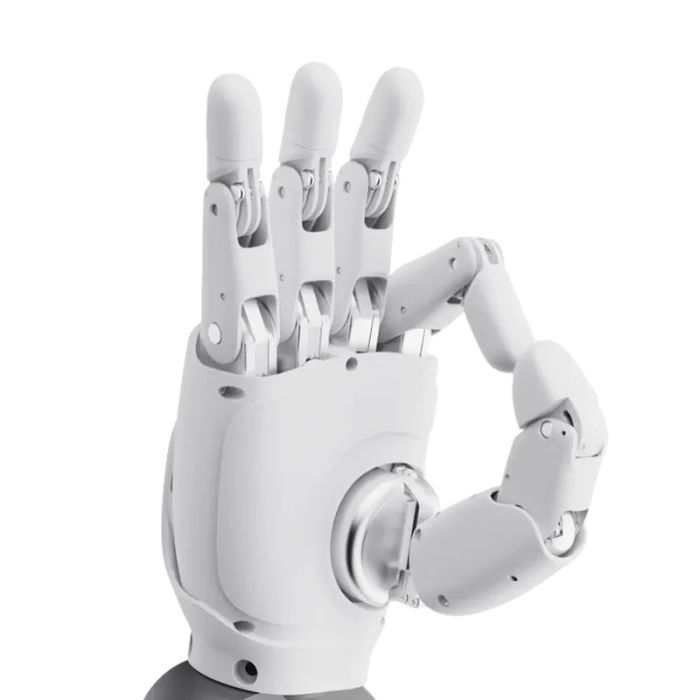
AgiBot OmniHand 2025 Interactive Dexterous Right Robot Hand
In stock
- BRAND:
- AGIBOT
- PART #:
- OmniHand 2025
- ORIGIN:
- China
- AVAILABILITY:
- SUBJECT TO AVAILABILITY
- SKU:
- AgiBot-OmniHand-2025
AgiBot OmniHand 2025 Interactive Dexterous Robot Hand + Free Shipping: Complete Guide
The OmniHand 2025 features 16 total degrees of freedom (10 active, 6 passive) in a 500-gram, 180-millimeter platform, with more than 400 touch-sensitive force control points across the hand and a tactile array resolution of 0.1 Newtons for contact detection. It communicates via CANFD and RS485 interfaces at 24 VDC and is supported by a full open-source SDK published at github.com/AgibotTech/Omnihand-2025-SDK under the Mulan PSL v2 license.
Design and Physical Features
180mm Length at 500 Grams: Built for Humanoid Integration
The OmniHand 2025 is designed from the ground up for integration into humanoid robot wrists. Its 180-millimeter total length and 500-gram weight match the dimensional envelope and payload constraints of current humanoid robot arms, including AgiBot's own A2 Ultra and X2 Ultra wrist interfaces, as well as the wrist interfaces of most major third-party collaborative robot arms and mobile manipulators.
At 500 grams, the OmniHand 2025 is lighter than the average adult human hand (approximately 400 to 500 grams), which means it does not add excessive distal mass to the robot arm's payload envelope. Lower distal mass reduces the inertial load on the robot's wrist and elbow joints during fast movements, improving the arm's dynamic performance and reducing joint motor demands.
AgiBot describes the 180mm compact form factor as providing "seamless compatibility with various humanoid robot models" — the hand is designed to be physically compatible across the range of current humanoid and cobot wrist attachment standards without requiring custom interface adapters.
Five-Finger Anthropomorphic Kinematic Layout
The OmniHand 2025 follows a human-inspired five-finger layout with an opposable thumb, index finger, middle finger, ring finger, and little finger. The thumb incorporates opposition kinematics — the ability to rotate across the palm to face the other fingers — which is the mechanical prerequisite for the full range of human grasping postures including precision pinch, lateral key grip, and tripod pinch. Without thumb opposition, a robotic hand is limited to power grasps and simple opposed-jaw configurations.
Digit lengths and joint center positions are calibrated for everyday objects at countertop and workstation height: cups, cartons, cylindrical handles, knobs, blister packs, tool handles, and the irregular packaging shapes that appear throughout retail, service, and light manufacturing environments. This calibration reflects the OmniHand 2025's primary deployment contexts — service robots, interactive reception robots, laboratory manipulation research, and light logistics tasks.
Innovative Back-of-Hand Touch Interaction
One of the OmniHand 2025's most distinctive features relative to conventional dexterous hands is its back-of-hand touch interaction capability. The hand incorporates touch-sensitive sensing on the dorsal (back) surface in addition to the palmar fingertip surfaces. This back-of-hand sensing enables the robot to detect when a human touches or taps the back of its hand during interaction — a natural human gesture used to indicate intent, request the hand to open, or signal handover of an object.
AgiBot describes this as supporting "innovative back-of-hand touch interaction" and notes that the hand "covers all common interactive gestures." For service robot deployments where the OmniHand 2025 is used in customer-facing interactions — reception, guidance, object handover — the back-of-hand touch channel provides a more intuitive human-robot interface than purely camera-based gesture recognition.
Anti-Pinch Safety Design
The OmniHand 2025 incorporates an anti-pinch design throughout its finger and palm geometry. Finger joints and closing paths are designed to prevent small objects, hair, clothing, or skin from being caught and compressed between closing finger links — a safety requirement for any dexterous hand operating in close proximity to human workers, customers, or patients.
The 400+ force control points across the hand provide continuous contact force monitoring that enables the hand's controller to detect and respond to unexpected contact events — including partial contact with a human body part — before the contact force exceeds safe limits.
Technology and Specifications
Core Specifications at a Glance
| Specification | Value |
|---|---|
| Total Degrees of Freedom | 16 (10 active, 6 passive) |
| Total Length | 180 mm |
| Weight | 500 g |
| Tactile Points | 400+ across the full hand |
| Tactile Array Resolution | 0.1 N |
| Maximum Fingertip Force | 5 N |
| Communication Interfaces | CANFD, RS485 |
| Operating Voltage | 24 VDC |
| Back-of-Hand Touch | Yes (innovative dorsal touch sensing) |
| Anti-Pinch Design | Yes |
| SDK | Open source (GitHub, Mulan PSL v2) |
| SDK Languages | Python and C++ |
| Simulation Support | URDF and 3D model resources |
| International Store Price | $4,420.00 USD |
| Domestic (China) Price | Approximately ¥9,800 (~$2,000 USD) |
| Package Contents | Hand x1, RS485 cable, CANFD cable, power cable, Type-C data cable, Certificate of Conformity |
16 Degrees of Freedom: 10 Active, 6 Passive
The 10 active degrees of freedom in the OmniHand 2025 are independently motor-actuated, providing precise control over the most dexterity-critical joint positions. The 6 passive degrees of freedom use mechanical compliance — underactuated differentials and tendon compliance — to allow the fingers to conform to the geometry of the object they are contacting without requiring the control system to independently command each phalanx to the exact contact angle.
This distribution is well-matched to the OmniHand 2025's primary use cases: the 10 independently controlled DOF are sufficient for the full range of common human hand gestures and manipulation postures, while the 6 passive DOF provide the object-conforming compliance that makes the hand practical for handling irregular and soft objects without complex real-time joint control.
The GitHub SDK repository documents all 10 active degrees of freedom with motor indexing (indexed 1 to 10), with individual joint control available through both position and velocity command modes in the Python and C++ APIs.
400+ Tactile Points at 0.1 N Resolution
The OmniHand 2025's tactile system provides more than 400 touch-sensitive force control points distributed across the finger surfaces and palm. At 0.1 Newton array resolution, the system can detect the onset of contact from small objects and gentle surface touches — including the detection of contact force from a standard sheet of paper or a thin fabric layer on a fingertip sensor.
The 400+ point distribution enables the hand's controller to build a contact map across the full hand surface during a grasp — knowing not just whether contact is occurring but where, how much force is applied at each contact zone, and how the contact distribution is changing during object manipulation. This spatial contact data enables contact-aware grasp control: tightening where slip is detected, redistributing grasp posture to maintain stable contact on soft or irregular objects, and triggering re-grasp when contact patterns indicate instability.
CANFD and RS485 Communication Interfaces
The dual communication interface — CANFD for high-bandwidth real-time control and RS485 for lower-bandwidth integration contexts — provides flexibility across the range of robot platforms and control architectures that the OmniHand 2025 is designed to serve. CANFD supports the real-time joint state feedback and control command exchange rates required for reactive tactile-based grasp control; RS485 supports integration into simpler robot arm control systems where CANFD is not available.
AgiBot's document center and GitHub SDK both support ZLG USBCANFD series adapters (USBCANFD-100U-mini, USBCANFD-100U, or USBCANFD-200U) for connecting the hand to a host computer during development and testing.
Open-Source SDK on GitHub
The OmniHand 2025 SDK is published at github.com/AgibotTech/Omnihand-2025-SDK under the Mulan PSL v2 open-source license, providing:
- Python binding module for rapid prototyping and research iteration
- C++ core source code for production deployment
- C++ example code for common manipulation tasks
- CANFD and RS485 device drivers (with ZLG USBCANFD and socket CAN support)
- Kinematics solver module for forward and inverse kinematics
- CMake-based build system for Linux x86_64 and ARM platforms
The Python interface is generated from the C++ source, ensuring that Python and C++ implementations share the same underlying protocol layer. This architecture allows development to start in Python for faster prototyping and transition to C++ for latency-sensitive production applications without rewriting control logic.
URDF model files and 3D CAD resources are published in AgiBot's document center, enabling import into NVIDIA Isaac Sim, MuJoCo, and other robotics simulation platforms for algorithm development and validation.
Applications and Use Cases
Humanoid Robot End-Effector Upgrade
The OmniHand 2025 is designed as a direct compatibility upgrade for humanoid robot wrists, providing human-like five-finger dexterity to platforms that would otherwise use simpler two-finger grippers or parallel jaw end-effectors. For AgiBot A2 Ultra and X2 Ultra users, and for third-party humanoid operators, attaching the OmniHand 2025 substantially expands the object and task diversity the robot can address in service, logistics, and interactive scenarios.
Interactive Service and Reception Robots
The OmniHand 2025's back-of-hand touch sensing, 400+ tactile points, anti-pinch safety design, and human gesture capability make it specifically suited for service robot applications requiring close human interaction — reception, guided tours, object handover, and customer assistance roles. The ability to both perform human-like gestures and detect human touch input provides a bidirectional tactile interface for more natural human-robot interaction than purely visual gesture recognition.
Robot Learning and Imitation Learning Research
For research teams developing manipulation policies through imitation learning, behavior cloning, and reinforcement learning, the OmniHand 2025's full tactile data stream provides contact information unavailable from camera or arm-level sensing alone. Demonstration data collected through teleoperation with the OmniHand 2025 — capturing both kinematic trajectories and tactile contact profiles — produces richer training datasets that improve the generalization and robustness of learned manipulation policies.
Logistics Bin Picking and Mixed SKU Sorting
In logistics pick-and-pack environments where items vary in size, weight, surface material, and packaging type, the OmniHand 2025's anthropomorphic grasping repertoire handles the object diversity that conventional vacuum and jaw grippers cannot cover within a single end-effector. The 16-DOF kinematics support precision pinch for small items, power grasp for larger packages, and lateral key grip for envelopes and flat packages — the full range of common logistics object profiles.
Education and University Research
The ¥9,800 domestic price point and $4,420 international price represent a significant accessibility improvement over research-grade dexterous hands priced at $15,000 to $25,000, enabling university robotics laboratories and student project teams to access genuine multi-finger dexterous manipulation hardware. The open-source SDK and URDF model resources support academic curriculum integration and reproducible experimental setups.
Light Industrial and Laboratory Automation
For laboratory automation tasks — sample handling, instrument operation, sorting, and pipette manipulation — the OmniHand 2025's 5 N maximum fingertip force and 0.1 N tactile resolution support the gentle, controlled contact required for laboratory glassware, reagent containers, and fragile biological samples.
Advantages and Benefits
First High-DOF Hand Under ¥10,000 — Industry Cost Breakthrough: The ¥9,800 price point established by AgiBot makes genuine 16-DOF dexterous manipulation accessible to a dramatically wider market than previous cost thresholds allowed, expanding the addressable customer base from well-funded research institutions to university labs, pilot projects, and startup robot developers.
500g at 180mm: Humanoid-Ready Dimensions Without Added Arm Load: The compact, lightweight design integrates directly into humanoid robot and cobot wrist interfaces without adding significant distal mass, preserving arm dynamic performance and payload capacity.
400+ Tactile Points for Contact-Aware Grasp Control: The high-coverage tactile sensing system enables stable grasping of challenging objects — deformable packaging, slippery surfaces, fragile containers — that defeat force-only and vision-only grip control.
Back-of-Hand Touch for Intuitive Human-Robot Interaction: The dorsal touch sensing channel enables humans to signal intent to the robot through natural hand-touch gestures, improving interaction naturalness in customer-facing service deployments.
Anti-Pinch Design for Safe Human-Proximate Operation: The safety-optimized finger geometry and force monitoring enable operation in close proximity to human workers, customers, and patients without risk of skin or clothing entrapment.
Open-Source SDK with Python and C++ on GitHub: Full development access without licensing fees, comprehensive documentation, and simulation-ready URDF resources reduce integration time and cost across research, education, and commercial deployment contexts.
$4,420 International Pricing with Free Shipping Available: Clear public pricing on AgiBot's international store, combined with free shipping from select authorized distributors, provides a transparent procurement path for international buyers.
Comparison: OmniHand 2025 vs. OmniHand Pro 2025
| Feature | OmniHand 2025 | OmniHand Pro 2025 |
|---|---|---|
| Total DOF | 16 (10 active, 6 passive) | 19 (12 active, 7 passive) |
| Weight | 500 g | ~750 g (650–950 g with sensors) |
| Length | 180 mm | Human-sized |
| Max Fingertip Force | 5 N | 15–25 N per digit |
| Power Grasp Force | Not specified | 35–60 N sustained |
| Sensing Resolution | 0.1 N array | 0.1 N multi-modal |
| Tactile Points | 400+ | Multi-cell arrays + slip detection |
| Palm F/T Sensor | Not included | Optional 6-axis F/T |
| Fingertip Design | Standard | Modular swappable |
| IP Rating | Standard | IP42–IP54 configurable |
| ESD-Safe Pads | Not listed | Available |
| International Price | $4,420 USD | Enterprise quotation |
| Primary Use | Interactive services, research, education | Industrial deployment, precision tasks |
The OmniHand 2025 prioritizes accessibility, compactness, and interactive service suitability — it is the right choice for humanoid integration, research, education, and light logistics. The OmniHand Pro 2025 prioritizes higher force output, greater sensing precision, configurable industrial protection, and modular maintenance capability — it is designed for heavier industrial tasks and high-precision manipulation contexts.
Pricing and Availability
AgiBot International Store (store.agibot.com): Listed at $4,420.00 USD. Available for direct enterprise purchase through AgiBot's official global store with international shipping.
JD.com (China domestic): Listed at approximately ¥9,800 — roughly $2,000 to $2,200 USD at current exchange rates. Domestic China buyers benefit from the lower domestic pricing tier.
Authorized International Distributors: Several authorized distributors provide the OmniHand 2025 internationally with free shipping to qualifying buyers in their service regions. Confirm free shipping eligibility and current pricing with your chosen distributor.
RCDrone (rcdrone.top): Lists the OmniHand 2025 in multiple configurations including standard and with tactile (OmniHand 2025w/Tactile), though availability at specific configurations should be confirmed directly.
Package Contents: Every standard OmniHand 2025 purchase includes the hand unit, RS485 Communication Cable, CANFD Communication Cable, Power Cable, Type-C Data Cable, and Certificate of Conformity.
Open-Source SDK: Available free at github.com/AgibotTech/Omnihand-2025-SDK under Mulan PSL v2. Full technical documentation (User Manual, Technical Specifications PDF, Host Software and Firmware, URDF/3D model) is published in AgiBot's document center.
Frequently Asked Questions (FAQ)
What is the AgiBot OmniHand 2025? The AgiBot OmniHand 2025 (OmniHand Agile 2025) is a compact five-finger dexterous robot hand developed by AgiBot with 16 total degrees of freedom (10 active, 6 passive), weighing 500 grams at 180 mm total length. It features more than 400 touch-sensitive force control points with 0.1 N tactile array resolution, a maximum fingertip force of 5 N, innovative back-of-hand touch sensing, an anti-pinch safety design, and CANFD and RS485 communication interfaces at 24 VDC. It is priced at $4,420 on AgiBot's international store, available at approximately ¥9,800 on JD.com, and supported by an open-source Python/C++ SDK on GitHub under the Mulan PSL v2 license.
How does the AgiBot OmniHand 2025 work? The 10 active degrees of freedom are independently motor-actuated through internal drives, with compliant tendon routing and underactuated differentials managing the 6 passive joints for object-conforming shape adaptation. The 400+ tactile array continuously maps contact force distribution across all finger and palm surfaces at 0.1 N resolution, feeding a controller that detects contact onset, grip stability, and slip events to trigger corrective grasp adjustments. The hand communicates joint state and tactile data to the host robot or computer through CANFD or RS485 interfaces, with control commands managed through the Python or C++ SDK.
What is the OmniHand 2025's SDK and where can I access it? The OmniHand 2025 SDK is published at github.com/AgibotTech/Omnihand-2025-SDK under the Mulan PSL v2 open-source license. It provides Python and C++ APIs for joint control and tactile data acquisition, CANFD and RS485 device drivers (with ZLG USBCANFD support), a kinematics solver module, and CMake build scripts for Linux platforms. URDF model files and 3D CAD resources are available through AgiBot's document center for simulation in NVIDIA Isaac Sim, MuJoCo, and other robotics platforms.
What is the difference between the OmniHand 2025 and the OmniHand Pro 2025? The OmniHand 2025 has 16 DOF (10 active, 6 passive), weighs 500 grams, has a maximum 5 N fingertip force, and is priced at $4,420 — targeting interactive service applications, research, and education. The OmniHand Pro 2025 has 19 DOF (12 active, 7 passive), weighs approximately 750 grams, provides 15 to 25 N fingertip force per digit and 35 to 60 N aggregate power-grasp force, features modular swappable fingertips, optional palm 6-axis F/T sensing, and configurable IP42 to IP54 industrial protection — targeting heavier industrial deployment contexts and precision manipulation tasks requiring greater force output and environmental ruggedness.
Summary
The AgiBot OmniHand 2025 Interactive Dexterous Robot Hand represents a significant commercial accessibility milestone in dexterous robotic manipulation: a genuine 16-DOF, five-finger anthropomorphic hand at 500 grams and 180 millimeters, with 400+ tactile points, 0.1 N contact sensing, back-of-hand touch interaction, and an open-source GitHub SDK — all at $4,420 USD on AgiBot's international store and approximately ¥9,800 on JD.com. By breaking the cost barrier that had previously confined high-DOF dexterous hands to well-funded research institutions, AgiBot has positioned the OmniHand 2025 as an accessible, developer-friendly entry point for humanoid robot operators, university research teams, service robot integrators, and pilot program developers seeking genuine multi-finger manipulation capability. Available with free shipping through select authorized international distributors and backed by comprehensive open-source tooling, the OmniHand 2025 provides a commercially accessible path from research-grade dexterous manipulation into production humanoid robot and service robot deployment.