
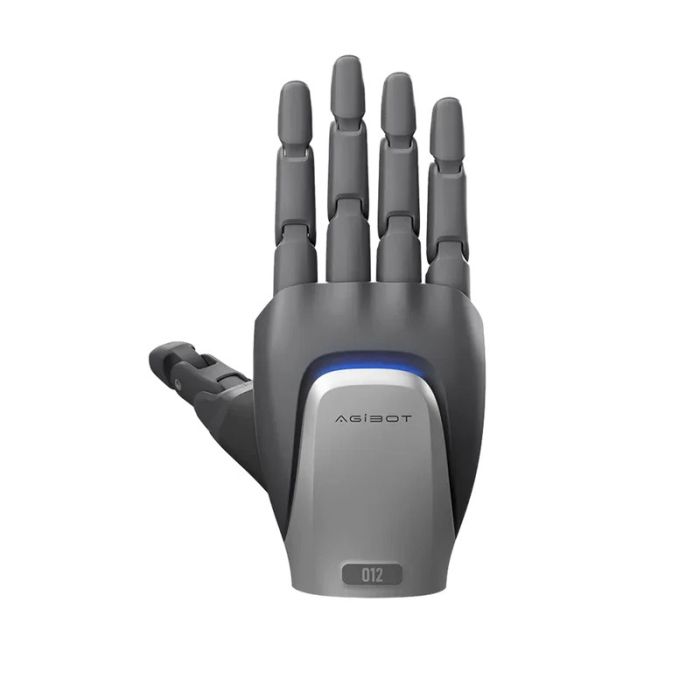
Agibot Omnihand Pro 2025 Anthropomorphic Five-Finger Dexterous Robot Hand
In stock
- BRAND:
- AGIBOT
- MODEL:
- OMNIHAND PRO 2025
- ORIGIN:
- China
- AVAILABILITY:
- SUBJECT TO AVAILABILITY
- SKU:
- AgiBot-OmniHand-Pro-2025
Agibot Omnihand Pro 2025
The OmniHand Pro 2025 features 19 total degrees of freedom (12 active, 7 passive) and weighs approximately 750 grams in standard configuration. Its sensing system provides 0.1-Newton resolution multi-modal feedback across tactile, force, and proprioceptive channels — a level of tactile sensitivity that enables the hand to detect and respond to contact events including slip, soft object deformation, and surface friction variation in real time. AgiBot released the OmniHand Pro 2025 as a standalone accessory available for purchase independently of AgiBot's humanoid robot platforms, with compatibility designed for both AgiBot robots (including the A2 Ultra and X2 Ultra) and third-party arms, collaborative robots, mobile manipulators, and custom research platforms. The hand is available with free shipping through authorized international distributors including American Satellite (americansatellite.us), and its full SDK is published as open source on GitHub under the Mulan PSL v2 license at github.com/AgibotTech/OmniHand-Pro-2025.
Anthropomorphic Five-Finger Layout
The OmniHand Pro 2025 follows a human-inspired five-finger kinematic layout with an independent opposable thumb, index finger, middle finger, ring finger, and little finger. Digit lengths and joint centers are calibrated to match everyday object dimensions — cups, cartons, knobs, cylindrical tools, packaging bags, and irregular components at workstation height — rather than being optimized for any single object category.
The thumb incorporates dedicated opposition kinematics — the ability to rotate the thumb across the palm to face the fingers — which is the mechanical prerequisite for precision pinch grasps, lateral key grips, and the full complement of human grasping postures. Without thumb opposition, a robotic hand is limited to power grasps and cannot execute the precision manipulation that the OmniHand Pro is specifically designed to perform.
19 Degrees of Freedom: 12 Active, 7 Passive
The OmniHand Pro 2025's 19 total degrees of freedom are distributed as 12 active (independently motor-actuated) and 7 passive (compliant/underactuated). The active degrees of freedom provide precise independent control over the most critical joint positions for grasp formation and in-hand manipulation; the passive degrees of freedom use mechanical compliance — springs, differentials, and underactuated tendons — to allow the fingers to conform to the shape of an object they are contacting rather than requiring the control system to independently command every joint to the correct position for each new object shape.
This blend of active and passive actuation is characteristic of state-of-the-art dexterous hands that must handle diverse object geometries in real-time deployment: fully active systems (all joints independently commanded) require extremely accurate perception and real-time control at every joint to grasp irregular objects successfully; fully passive systems (pure compliance) lack the precision control needed for fine manipulation. The OmniHand Pro's 12+7 distribution balances these requirements, with the most dexterity-critical joints (thumb, index distal phalanx) receiving independent motor actuation and the more structurally repetitive joints (middle phalanges, lateral fingers) receiving compliant underactuation.
Modular Fingertip Design
The OmniHand Pro 2025 features a modular fingertip design that allows individual fingertip modules to be swapped without replacing the entire hand. This modularity serves two purposes: it reduces the maintenance cost and downtime when a fingertip tactile pad wears or is damaged in deployment; and it enables the fingertip configuration to be adapted for different application requirements — standard-density tactile pads for general manipulation, high-density gel pads for maximum tactile sensitivity in precision grasping research, and electrostatic discharge (ESD)-safe pads for electronics assembly environments.
750 Gram Target Weight
At approximately 750 grams, the OmniHand Pro 2025 is 50 percent heavier than the entry-level OmniHand 2025's 500-gram target weight — reflecting the additional sensing hardware, more complex actuation system, and modular fingertip mounting hardware of the Pro variant. The 750-gram figure is the baseline; configurations with optional palm-level 6-axis force/torque sensing and high-density tactile pads reach up to approximately 950 grams depending on the specific sensor loadout.
Technology and Specifications
Core Specifications
| Specification | Value |
|---|---|
| Total Degrees of Freedom | 19 (12 active, 7 passive) |
| Weight (standard) | Approximately 750 g |
| Weight (full sensor configuration) | 650 to 950 g (sensor loadout dependent) |
| Thumb DOF | 4 (including opposition) |
| Sensing Resolution | 0.1 N multi-modal |
| Peak Fingertip Force | 15 to 25 N per digit (configuration dependent) |
| Aggregate Power-Grasp Force | 35 to 60 N sustained |
| Fingertip Repeatability | Less than 0.5 mm in calibrated workspace |
| Tactile Sensing | Multi-cell fingertip arrays with slip detection; high-density gel pads optional |
| Palm Sensing | Optional 6-axis F/T for whole-hand force control |
| Position Fidelity | Sub-degree joint sensing |
| Materials | Aluminum subframe, polymer/fiber-reinforced shells |
| ESD Protection | ESD-safe pads available |
| Ingress Protection | IP42 to IP54 options (light dust and splash) |
| Operating Voltage | 24 VDC |
| Peak Power Consumption | Less than 80 W during firm power grasps |
| Thermal Management | Passive heat spreading with onboard temperature monitoring |
| Communication Interfaces | CANFD, RS485 |
| SDK Availability | Open source, GitHub (Mulan PSL v2) |
| SDK Languages | Python and C++ |
| Simulation Support | URDF and 3D model resources |
| Documentation Release | December 16, 2025 (updated February 1, 2026) |
Multi-Modal Sensing at 0.1-Newton Resolution
The 0.1-Newton sensing resolution of the OmniHand Pro 2025 is its most consequential sensing specification. To contextualize this figure: a standard sheet of paper exerts approximately 0.01 to 0.05 Newtons of contact force when placed on a fingertip sensor; the ability to measure at 0.1 N resolution means the OmniHand Pro can detect the weight of small components, the onset of contact with delicate surfaces, and the beginning of slip before the grasped object has moved detectably.
The multi-modal character of the sensing means the 0.1 N resolution applies across three physical channels:
Normal force — the perpendicular contact pressure between the fingertip surface and the object — quantifies grip force and enables the robot to avoid crushing soft or fragile objects while applying sufficient force to prevent slip.
Shear force — the tangential force parallel to the contact surface — detects the onset of object sliding before full slip occurs, triggering corrective grasp tightening or micro-reorientation before the object is dropped.
Vibration and micro-texture signals — the tactile signature of surface texture, edge detection, and the beginning of slip — provide information about surface properties that neither camera vision nor arm-level force sensors can reliably measure.
Compliant Tendon-Driven Actuation
The OmniHand Pro uses compact BLDC (brushless DC) and coreless micro-drive motors with compliant tendon routing. The tendon transmission provides mechanical compliance — a small amount of elastic "give" in the drive system — that absorbs unexpected contact forces, reduces the risk of mechanical damage when the hand contacts obstacles unexpectedly, and provides a series-like elastic compliance that makes the hand safer to operate near human workers.
Tendon routing also allows the drive motors to be located in the palm and wrist rather than at the finger joints themselves, reducing the mass and inertia at the fingertips. Lower fingertip inertia improves the responsiveness of the fingers to fast contact events and reduces the impact force when the hand touches an object at speed.
SDK: Python and C++ on GitHub
The OmniHand Pro 2025 SDK is published at github.com/AgibotTech/OmniHand-Pro-2025 under the Mulan PSL v2 open-source license. The SDK provides:
- Python binding module (generated from C++ source code) for rapid prototyping
- C++ core source for production deployment
- Example code for common control tasks
- USBCANFD interface integration (ZLG USBCANFD-100U-mini or USBCANFD-100U recommended)
- Build scripts (CMake-based) for Linux x86_64 and ARM platforms
The SDK supports both dexterous hand control (commanding individual joint positions, velocities, and torques) and data acquisition (reading tactile arrays, joint state, and F/T sensor data) in real time. Python and C++ interfaces share the same underlying protocol layer, allowing development to begin in Python and transition to C++ for latency-sensitive production implementations without rewriting control logic.
AgiBot's document center also provides URDF (Unified Robot Description Format) model files and 3D model resources for the OmniHand Pro 2025, enabling direct import into NVIDIA Isaac Sim, MuJoCo, and other robotics simulation environments for development and validation before physical hardware deployment.
Applications and Use Cases
Humanoid Robot End-Effector
The OmniHand Pro 2025 is designed as an end-effector upgrade for humanoid robot arms, including AgiBot's own A2 Ultra and X2 Ultra platforms. Replacing a simpler gripper or a lower-DOF hand with the OmniHand Pro substantially expands the range of objects and tasks the robot can handle, enabling the humanoid to work with the full diversity of everyday objects rather than being limited to the subset of items that two-finger or vacuum grippers can pick.
Collaborative Robot and Mobile Manipulator Integration
For third-party collaborative robot arms (cobots) and mobile manipulators, the OmniHand Pro provides a human-like grasping interface that allows the arm system to be deployed in environments and tasks requiring hand-like dexterity — light assembly, sorting mixed SKUs, pharmaceutical dispensing, lab automation, and customer-facing service roles. The standardized CANFD and RS485 interfaces, combined with the open SDK, enable integration with a wide range of arm platforms without requiring custom communication protocol development.
Robotic Policy Learning and Imitation Learning Research
The OmniHand Pro's tactile sensing and open SDK make it particularly valuable for research teams developing robot manipulation policies through imitation learning and reinforcement learning. The tactile data stream provides contact information that is not available from camera or arm-level sensing alone, enabling the development of policies that are robust to object variation, surface properties, and grasp uncertainty — research areas that are currently central to the embodied AI and robot learning fields.
Teleoperation demonstration data collected through the OmniHand Pro — capturing both the kinematic trajectory of the hand and the tactile contact profile during manipulation — provides substantially richer training data for behavior cloning and inverse reinforcement learning than kinematic-only teleoperation systems.
Electronics and Precision Parts Assembly
The ESD-safe pad option and IP42 to IP54 ingress protection make the OmniHand Pro suitable for electronics manufacturing and precision parts handling environments. ESD protection prevents the hand from damaging electrostatic-sensitive components during contact, enabling deployment in PCB handling, semiconductor component testing, and electronics assembly without risk of component damage from static discharge.
The 0.1 N sensing resolution and less than 0.5 mm fingertip repeatability support the precision placement requirements of electronics assembly tasks, where component leads must be aligned to PCB pads with millimeter or sub-millimeter accuracy.
Logistics and Parcel Sorting
In logistics sorting environments where items vary widely in size, weight, surface material, and packaging type — cardboard boxes, padded envelopes, polybags, glass containers, soft pouches — the OmniHand Pro's anthropomorphic grasping capability and tactile slip detection handle the object diversity that conventional vacuum and jaw grippers cannot cover within a single end-effector. The aggregate 35 to 60 N power grasp force supports the secure holding of standard parcel weights through dynamic conveyor movements.
Healthcare and Pharmaceutical Handling
In pharmacy automation and healthcare material handling contexts, the OmniHand Pro's precise grasping of pharmaceutical packaging — blister packs, bottles, syringes, pouches — combined with its 0.1 N sensing resolution for gentle contact with fragile containers, addresses the handling requirements of medication dispensing and medical supply management robots.
Advantages and Benefits
19 Total DOF at 750 Grams Delivers Human-Scale Dexterity at Commercial Weight: The OmniHand Pro achieves the degree-of-freedom count associated with research-grade dexterous hands in a platform weight appropriate for deployment on collaborative robot arms and humanoid robot wrists.
0.1 N Multi-Modal Sensing for Slip Detection and Gentle Grasping: The sub-0.1 N tactile sensitivity enables stable grasping of deformable, slippery, and delicate objects including soft packaging, glass containers, and polished metal components that challenge force-only and vision-only grip control.
Modular Fingertips for Maintenance and Application Flexibility: Field-swappable fingertip modules reduce maintenance downtime and enable application-specific configuration without replacing the complete hand assembly.
Open-Source SDK on GitHub Under Mulan PSL v2: Full Python and C++ development access without licensing fees, URDF model support for simulation, and active GitHub repository reduce development time and cost for integration teams and research labs.
IP42 to IP54 Options for Industrial Deployment: Configurable ingress protection supports deployment in light industrial and commercial environments with dust and splash exposure, extending the hand's applicable context beyond strictly controlled laboratory settings.
ESD-Safe Pads Available for Electronics Manufacturing: The ability to configure ESD protection expands the OmniHand Pro into electronics assembly and semiconductor handling applications where standard fingertip materials would risk component damage.
Free Shipping Through American Satellite: American Satellite (americansatellite.us) provides the OmniHand Pro 2025 with free shipping to qualifying buyers, eliminating shipping cost as a procurement variable.
Comparison: OmniHand Pro 2025 vs. OmniHand 2025
| Feature | OmniHand 2025 | OmniHand Pro 2025 |
|---|---|---|
| Total DOF | 16 (10 active, 6 passive) | 19 (12 active, 7 passive) |
| Weight | ~500 g | ~750 g |
| Sensing Resolution | Standard tactile arrays | 0.1 N multi-modal |
| Fingertip Design | Standard | Modular, swappable |
| Palm F/T Sensor | Not listed | Optional 6-axis F/T |
| Price | ¥9,800 | Higher (enterprise quotation) |
| IP Rating | Standard | IP42 to IP54 configurable |
| ESD-Safe Pads | Not listed | Available |
| Primary Target | Interactive services, research | Industrial deployment, precision tasks |
The OmniHand 2025 is optimized for interactive service applications and cost-accessible research with its 16 DOF at 500 grams and ¥9,800 price point. The OmniHand Pro 2025 is optimized for industrial deployment environments requiring higher sensing precision, greater kinematic capability, and more robust environmental protection — at the cost of higher weight and price. Both share AgiBot's open-source SDK approach and CANFD/RS485 interface standards.
Frequently Asked Questions (FAQ)
What is the AgiBot OmniHand Pro 2025? The AgiBot OmniHand Pro 2025 (OmniHand 专业款 2025) is a premium anthropomorphic five-finger dexterous robot hand developed by AgiBot with 19 total degrees of freedom (12 active, 7 passive), weighing approximately 750 grams, and providing 0.1-Newton resolution multi-modal tactile sensing with slip detection. It features modular swappable fingertips, optional 6-axis palm force/torque sensing, IP42 to IP54 configurable ingress protection, ESD-safe pad options, 24 VDC power, CANFD and RS485 interfaces, and an open-source Python/C++ SDK on GitHub. It is available with free shipping through American Satellite.
How does the AgiBot OmniHand Pro 2025 work? The hand uses compact BLDC and coreless micro-drive motors with compliant tendon routing to independently actuate 12 active degrees of freedom while 7 passive joints provide mechanical compliance for shape adaptation to irregular object geometries. Multi-cell fingertip tactile arrays sense normal pressure, shear force, and micro-texture signals at 0.1 N resolution, feeding a controller that triggers grasp reflexes (tighten, micro-roll, re-grasp) to stabilize objects when slip is detected. The SDK's Python and C++ APIs command joint positions, velocities, and torques while reading tactile and joint state data through a CANFD interface.
What is the difference between the OmniHand Pro 2025 and the OmniHand 2025? The OmniHand 2025 has 16 total DOF (10 active, 6 passive), weighs approximately 500 grams, and is priced at ¥9,800 — targeting interactive service applications and accessible research. The OmniHand Pro 2025 has 19 total DOF (12 active, 7 passive), weighs approximately 750 grams, and provides 0.1 N multi-modal sensing, modular swappable fingertips, optional palm 6-axis F/T sensing, IP42 to IP54 configurable protection, and ESD-safe pad options — targeting industrial deployment, precision assembly, and research requiring higher tactile fidelity.
What SDK and simulation support does the OmniHand Pro 2025 have? The OmniHand Pro 2025 SDK is published open source at github.com/AgibotTech/OmniHand-Pro-2025 under the Mulan PSL v2 license. It provides Python and C++ APIs for joint control and tactile data acquisition, with CMake build scripts for Linux x86_64 and ARM platforms. AgiBot's document center provides URDF model files and 3D CAD resources for import into NVIDIA Isaac Sim, MuJoCo, and other robotics simulation environments. Formal technical documentation (User Manual, Technical Specifications PDF, Host Software and Firmware) is published at agibot.com/filepage/277.html, updated February 1, 2026.
Summary
The AgiBot OmniHand Pro 2025 represents a commercially accessible implementation of research-grade anthropomorphic dexterous hand technology, with 19 total degrees of freedom, 0.1-Newton multi-modal tactile sensing, modular swappable fingertips, configurable IP42 to IP54 protection, and a full open-source Python/C++ SDK on GitHub — all at the 750-gram weight class appropriate for deployment on collaborative robot arms, mobile manipulators, and humanoid robot wrists. Positioned above the accessible entry-level OmniHand 2025 for industrial deployment environments requiring higher precision sensing, greater kinematic capability, and robust environmental protection, the OmniHand Pro 2025 addresses the real manipulation requirements of logistics sorting, electronics assembly, pharmaceutical handling, precision parts manipulation, and embodied AI research programs. Available with free shipping through American Satellite and backed by AgiBot's open-source developer ecosystem, the OmniHand Pro 2025 provides an internationally accessible, well-documented, and developer-friendly pathway from research-grade dexterous manipulation into production-grade robotic deployment.