
Deep Robotics DR01 Humanoid Robot
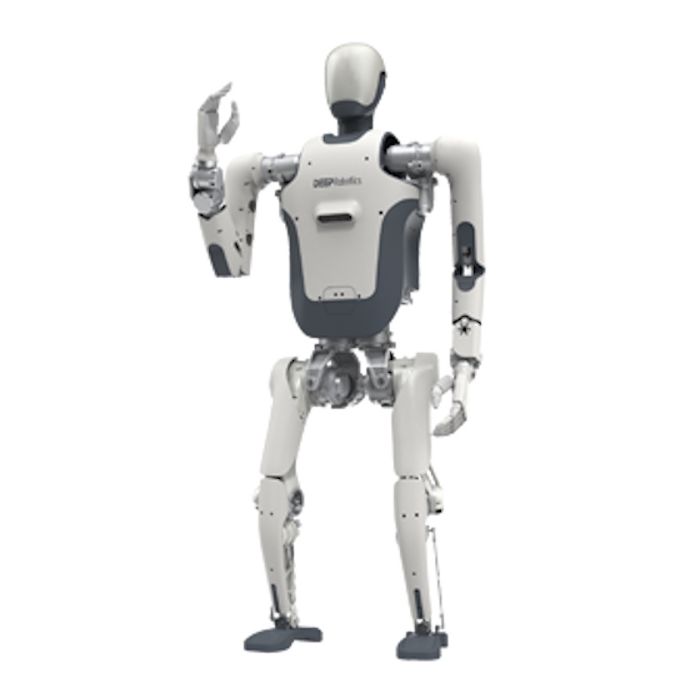
In stock
- BRAND:
- DEEP ROBOTICS
- PART #:
- DR01
- ORIGIN:
- China
- AVAILABILITY:
- SUBJECT TO AVAILABILITY
- SKU:
- Deep-Robotics-DR01
Deep Robotics DR01 Humanoid Robot
Design and Features
Bipedal locomotion focused on stability under disturbance
DEEP Robotics highlights the DR01’s robust walking under uncertain conditions. On its official DR01 page, the company states the robot can maintain stable locomotion and recover balance even under “unknown disturbances” such as slippery surfaces and external forces.
In reporting reposted on DEEP Robotics’ site, demonstrations are described as including stair climbing, walking across steel bars, and maintaining gait stability while being pushed or pulled.
Fusion perception for discrete and complex terrain traversal
A central theme in the DR01’s positioning is what DEEP Robotics calls “Fusion Perception Capability”—integrating the robot’s self-perception with environmental perception and using a learning algorithm that combines sensing and control for stable traversal across complex, discontinuous terrain.
In practical terms, this describes an approach where locomotion robustness is treated as a combined perception–control problem, rather than relying only on pre-scripted gait patterns.
Autonomous learning framed as an “embodied intelligence” platform
DEEP Robotics also emphasizes autonomous learning: the company says that through AI and big-data training, DR01 can generate new behavioral skills in response to changing environments and evolving task requirements.
Third-party event coverage similarly frames the robot as an “AI plus” intelligent physical agent intended to evolve through training cycles.
Proprietary joints and core components
On the official DR01 page, DEEP Robotics states the robot is equipped with self-developed J60 lightweight joints and J100 high-torque joints.
Multiple industry outlets repeating the WRC announcement also highlight these proprietary joints as a core differentiator supporting flexible movement and robustness.
Technology and Specifications
Unlike some commercial robots that publish full datasheets publicly, DEEP Robotics’ DR01 landing page emphasizes capability claims and platform intent more than a comprehensive specification table. The following items are explicitly stated by DEEP Robotics:
Mobility (published capability targets)
-
Walking speed: over 1.6 m/s
-
Obstacle/terrain: can navigate 18 cm steps, 25° slopes, and uneven terrain
-
Disturbance recovery: balance recovery and stable walking under slippery surfaces and external forces (as described by the company)
Learning and control approach (as described)
-
Learning algorithm combining sensing and control for stable traversal on complex/discrete terrain
-
Autonomous learning positioned as skill generation through AI and big-data training
Applications and Use Cases
Embodied AI training and research platform
DEEP Robotics explicitly frames DR01 as a platform for AI and big data training intended to accelerate embodied intelligence iteration.
This positioning aligns with research workflows such as learning-based locomotion, robust control, and whole-body behavior generation especially where the robot’s interaction with real-world terrain provides high-value training data.
Industrial productivity and high-precision repetitive tasks
Event coverage and industry reporting around the WRC debut describe an expected trajectory where humanoid robots assist with repetitive, high-precision tasks, improving productivity in industrial settings.
In this framing, DR01 is less a finished “single-purpose product” and more a development platform intended to mature through training and deployment iterations.
Hazardous environment and safety-support roles
Multiple reports connected to the WRC launch highlight a safety rationale: humanoids that can operate in hazardous environments may help safeguard personnel and reduce exposure to risk.
DEEP Robotics’ legacy in field robotics and inspection (via quadrupeds) is often cited as background for why the company emphasizes robustness and stability.
Demonstration-driven validation of locomotion robustness
A notable part of DR01’s early public narrative is demonstration footage and reports emphasizing stability under pushes, pulls, and uneven terrain—used to communicate readiness for real-world locomotion challenges beyond controlled lab floors.
Advantages / Benefits
Robust mobility claims for real environments
From an engineering standpoint, the most distinctive benefit in the DR01’s public description is its emphasis on recovering balance and continuing stable walking under uncertain disturbances—an area that remains challenging for many bipedal humanoids.
Integrated “learning + locomotion” platform positioning
DEEP Robotics repeatedly ties DR01 to an iterative training loop: AI/big-data training → new behaviors → improved embodied intelligence. This makes the DR01’s narrative particularly aligned with organizations prioritizing learning-driven robotics over fixed-function automation.
Proprietary joint stack (J60 / J100)
By naming its joint families (J60 lightweight; J100 high-torque) as core components, DEEP Robotics signals vertical integration in actuation—often associated with improved performance tuning, supply control, and long-term platform iteration.
FAQ Section
What is the Deep Robotics DR01 Humanoid Robot?
The Deep Robotics DR01 (Dr.01) is a bipedal humanoid robot positioned by DEEP Robotics as an embodied intelligence explorer—a platform for AI and big-data training to advance embodied intelligence and explore humanoid applications.
How does the DR01 work?
DEEP Robotics describes DR01 as combining fusion perception (self + environmental perception) with a learning algorithm that links sensing and control, enabling stable walking on complex and discrete terrain. The company also emphasizes autonomous learning, where training enables new behavioral skills.
Why is the DR01 important?
DR01 is presented as DEEP Robotics’ first humanoid and a strategic move beyond quadrupeds into humanoids. Its public messaging focuses on robust locomotion under disturbance and training-driven skill growth—two priorities that are central to practical humanoid deployment in real environments.
What are the benefits of the DR01?
DEEP Robotics’ published benefits include walking speed over 1.6 m/s, ability to traverse 18 cm steps and 25° slopes, balance recovery under disturbances, fusion perception for terrain traversal, and proprietary J60/J100 joints supporting flexible movement.
Summary
The Deep Robotics DR01 (Dr.01) Humanoid Robot is positioned as an embodied intelligence development platform that emphasizes robust bipedal mobility, fusion perception, and training-driven autonomous learning. Public information from DEEP Robotics and industry coverage centers on DR01’s ability to maintain stable walking under disturbances, traverse steps and slopes, and evolve through AI/big-data training—framing the robot as a foundation for future humanoid applications in industrial productivity, safety support, and advanced robotics research.