
Deep Robotics LYNX M20 Pro Omni Terrain EDU Wheeled Quadruped Robot Dog
In stock
- BRAND:
- DEEP ROBOTICS
- PART #:
- LYNX M20 Pro
- ORIGIN:
- China
- AVAILABILITY:
- ALLOW 2-4 WEEKS FOR DELIVERY
- SKU:
- Deep-Robotics-LYNX-M20-Pro
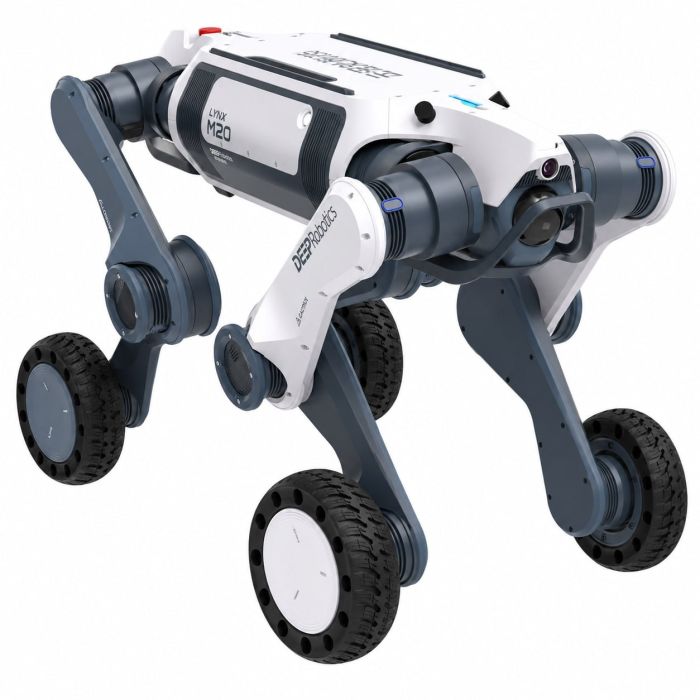
LYNX M20 Omni Terrain EDU Wheeled Quadruped Robot Dog (LYNX M20 Pro)
In published product materials, the LYNX M20 series is positioned for demanding field scenarios—such as power and infrastructure inspection, emergency response support, logistics, and scientific exploration where ground conditions vary from smooth corridors to rubble, mud, and steep inclines.
The “EDU” designation is used by some resellers to identify an education-focused offering of the M20 Pro (often described as suitable for learning, training, and research workflows). These EDU listings typically frame the platform as appropriate for academic programs and secondary development (custom software/behavior development), while keeping the underlying “Pro” industrial-grade mobility and sensor stack.
Design and Features
Wheel-leg architecture and adaptive mobility
The LYNX M20 Pro’s defining feature is its wheel-leg locomotion, in which each limb ends in a wheel while the joints provide leg-like articulation. DEEP Robotics describes the system as balancing speed and agility and emphasizes adaptability to diverse terrain, including narrow passages and obstacle-rich routes.
Manufacturer-published mobility performance targets include:
-
Max continuous stair height: 25 cm
-
Max single-step height: 80 cm
-
Max slope: 45°
Industrial ruggedization
DEEP Robotics lists IP66 ingress protection and an operating temperature range of −20°C to 55°C, indicating a chassis designed for harsh outdoor and industrial environments (dust exposure, strong spray, and significant temperature variation).
Autonomy-oriented sensing and onboard compute
Official specification pages list a perception stack centered on dual 96-line LiDAR and dual wide-angle cameras, supported by onboard industrial computing hardware. The same sources list navigation-oriented functions such as omnidirectional obstacle avoidance and a point-cloud surround view (with notes that some functions may be enabled via OTA depending on software version).
The published compute configuration is dual octa-core 64-bit industrial processors (16GB + 128GB) ×2, reflecting a design intended for on-robot perception and autonomy workloads rather than relying solely on remote processing.
External interfaces and expansion
DEEP Robotics lists 72V power input and Gigabit Ethernet as external electrical interfaces, supporting payload integration (e.g., additional sensors, communication modules, or task-specific inspection equipment).
The product pages also reference modular expansion and optional autonomous charging/self-charging, positioning the platform for longer-duration or repeatable mission cycles when configured accordingly.
Technology and Specifications
Publicly listed specifications for the LYNX M20 Pro (often shared across the LYNX M20 series) include:
Physical characteristics and payload
-
Standing dimensions: 820 mm × 430 mm × 570 mm
-
Weight (incl. battery): 33 kg
-
Payload capacity: 15 kg
-
Max load capacity: 50 kg
Endurance and range (published)
-
Unloaded endurance / range: 3 h / 15 km
-
Loaded endurance / range (15 kg): 2.5 h / 12 km
-
Charging time (single battery): 1.5 h
Speed and mobility limits (published)
-
Lab-tested maximum speed: 5 m/s
-
Operating maximum speed: 2 m/s
Sensors, perception, and autonomy features
-
LiDAR: 2 × 96-line (listed as 360° × 90° FOV and ~860,000 points/s)
-
Cameras: 2 × wide-angle
-
Listed features: omnidirectional obstacle avoidance, point-cloud surround view, RF image transmission, OTA upgrades
Applications and Use Cases
Education and research (“EDU”) use
Resellers frequently market the M20 Pro EDU as appropriate for education and research, typically emphasizing “secondary development” (custom software development and behavior customization).
In this context, the robot can serve as a teaching platform for topics such as mobile robotics, autonomy, mapping with LiDAR, perception pipelines, motion planning, and field-robot safety constraints, while remaining rugged enough for outdoor testing.
Industrial inspection and infrastructure monitoring
DEEP Robotics positions the LYNX M20 series for power inspection and other infrastructure scenarios. The combination of IP66 ruggedization, dual LiDAR, and a meaningful payload capacity supports sensor payloads and operation in dusty, wet, or temperature-variable sites.
Emergency response and hazardous-environment reconnaissance
In published descriptions, the LYNX M20 Pro is framed as suitable for hazardous environments and emergency work, where remote situational awareness and mobility reduce human exposure. A CES Innovation Awards entry for the LYNX M20 Pro highlights use cases including emergency rescue and scientific exploration, and describes the robot as a wheel-leg quadruped for complex terrains.
Logistics and field operations in mixed terrain
The wheel-leg mobility profile is well aligned with mixed-terrain logistics—for example, moving across paved sections efficiently while maintaining the ability to traverse steps, debris, or uneven transitions. Published ranges (15 km unloaded; 12 km with 15 kg load) reflect this field-operations positioning.
Advantages / Benefits
Hybrid mobility: efficient rolling plus obstacle capability
A core benefit of the M20 Pro architecture is its attempt to bridge a classic robotics trade-off: wheels are efficient on flat ground, while legged systems handle discontinuities such as steps and rubble. The LYNX M20 Pro’s published stair and step parameters (25 cm continuous stairs, 80 cm single step) summarize this intended hybrid advantage.
Field-ready ruggedization with industrial interfaces
IP66 protection, a broad operating temperature range, and straightforward integration ports (72V power input, Gigabit Ethernet) are central to the platform’s positioning as a deployable field robot rather than a lab-only prototype.
Secondary development orientation for EDU and advanced R&D
Third-party listings and summaries commonly describe the M20 Pro as supporting “secondary development” and being suited to research/education contexts—an important distinction for universities, labs, and training programs that require programmability and repeatable experiments.
FAQ Section
What is the Deep Robotics LYNX M20 Pro Omni-Terrain EDU robot dog?
It is a wheel-legged quadruped robot (wheeled quadruped “robot dog”) designed for mixed terrain. Official specs list 33 kg weight, 15 kg payload, dual 96-line LiDAR, and IP66 protection; some resellers label the EDU offering as intended for education and secondary development.
How does the LYNX M20 Pro work?
The robot combines wheels with articulated legs to switch between efficient rolling and posture-controlled obstacle traversal. DEEP Robotics lists autonomy-oriented sensing (dual 96-line LiDAR and wide-angle cameras) and features such as obstacle avoidance and point-cloud surround view.
Why is the LYNX M20 Pro important?
It targets a key gap in field robotics: reliable mobility across complex, changing terrain without losing efficiency on flat segments. Public descriptions highlight ruggedization (IP66), industrial compute, and mobility performance parameters intended for hazardous or demanding environments.
What are the benefits of the LYNX M20 Pro?
Published benefits include 15 kg payload, 2.5 hours / 12 km under 15 kg load, IP66 protection, dual 96-line LiDAR, and step/slope capability (25 cm continuous stairs, 80 cm single step, 45° slope). EDU-oriented listings additionally emphasize secondary development for customized behaviors and research workflows.
Summary
The Deep Robotics LYNX M20 Pro Omni-Terrain EDU Wheeled Quadruped Robot Dog is a wheel-legged quadruped platform that combines rolling efficiency with legged obstacle capability for mixed, demanding terrain. Official specifications emphasize an IP66 chassis, dual 96-line LiDAR, industrial onboard compute, and field-ready mobility targets (including 25 cm continuous stairs, 80 cm single-step traversal, and 45° slopes), while EDU-positioned offerings highlight suitability for education, research, and secondary development. Together, these attributes place the LYNX M20 Pro EDU in the category of rugged, program-ready embodied mobility platforms intended for both real-world operations and advanced robotics learning environments.