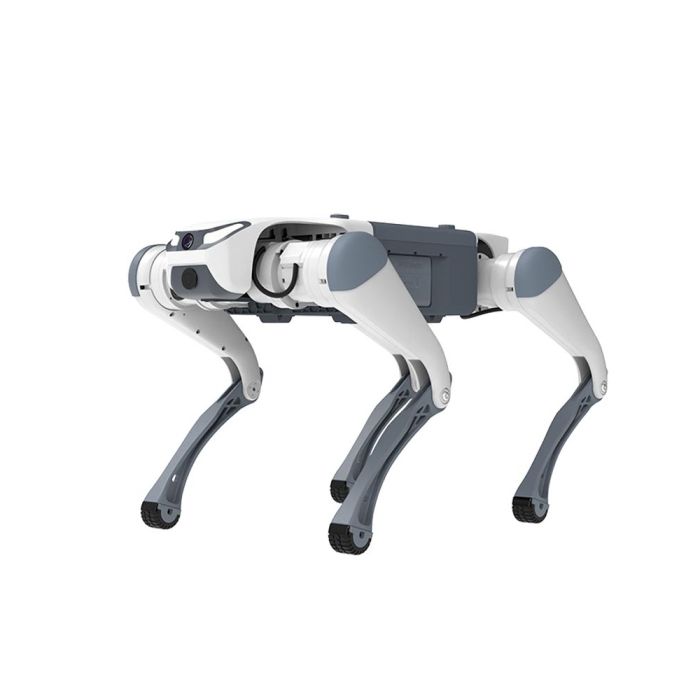
Deep Robotics Lite3 Academic & Research Quadruped Robot Dog
In stock
- BRAND:
- DEEP ROBOTICS
- PART #:
- Lite3
- ORIGIN:
- China
- AVAILABILITY:
- ALLOW 2-4 WEEKS FOR DELIVERY
- SKU:
- Deep-Robotics-Lite3
Lite3 Academic & Research Quadruped Robot Dog (Lite3)
It is marketed as a modular “robot dog” intended to help universities, labs, and developers prototype locomotion, perception, and autonomy features—ranging from gait control and reinforcement learning to mapping and navigation—without designing a legged robot from scratch.
Deep Robotics’ own descriptions emphasize a combination of enhanced joint torque, improved locomotion algorithms, and expandable modules, framing Lite3 as a practical research tool for teaching and experimentation in embodied AI and legged robotics.
Design and Features
Lightweight chassis and modular expansion
Lite3 is described as an “advanced, lightweight quadruped robotic platform” with a modular design intended for add-on components and evolving research needs. Deep Robotics highlights its “modular design for unlimited possibilities,” positioning the platform for diverse curricula (controls, robotics software) and lab work (perception, autonomy).
Mobility-first architecture for research scenarios
Deep Robotics’ Lite3 messaging focuses on agile mobility and responsive control—useful for studying legged locomotion behaviors such as dynamic gait transitions, stability under disturbance, and terrain adaptation. The company states the platform features a 50% increase in joint torque and improvements to response bandwidth and transmission efficiency.
Education-oriented development ecosystem
For academic use, Deep Robotics promotes a development ecosystem that includes documentation and development interfaces. In an education-oriented solution document, the company describes providing manuals and secondary development interfaces/SDK routines for low-level control, including joint position, velocity, and torque control, with support for ROS-based development.
Technology and Specifications
Core physical and mobility specifications (by configuration)
Deep Robotics publishes Lite3 specifications in multiple configurations (commonly Basic, Venture, Pro, and LiDAR). On its official Lite3 page, the company lists:
-
Basic: 610 × 370 × 406 mm, 12 kg, 5 kg payload, 40° max slope, 18 cm obstacle clearance, 1.5–2 hours continuous operation, up to 5 km range.
-
Venture: 610 × 370 × 445 mm, 12.2 kg, 4.5 kg payload, 40° slope, 18 cm obstacle clearance, 1.5–2 hours operation, up to 4 km range; interfaces include Ethernet ×2 and external power input options.
-
Pro: 610 × 370 × 450 mm, 12.9 kg, 4 kg payload, 40° slope, 18 cm obstacle clearance, 1.5–2 hours operation, up to 3.4 km range; interfaces include USB 3.0, HDMI, Ethernet.
-
LiDAR: 610 × 370 × 496 mm, 13.5 kg, 2.5 kg payload, 40° slope, 18 cm obstacle clearance, 1.5–2 hours operation, up to 2.7 km range; includes “autonomous navigation” as a listed perception feature.
Development interfaces and software stack
Deep Robotics’ education materials emphasize secondary development based on ROS, offering software packages for mapping/localization/navigation and SDK routines for low-level motion control (including joint torque control).
On its Lite3 FAQ, Deep Robotics also states Lite3 supports open SDK and API access and allows motion/perception development on ROS1 and ROS2.
Compute hardware (as described by Deep Robotics)
According to Deep Robotics’ Lite3 FAQ page, Lite3 uses an RK3588 ARM processor as a motion host, and (for Pro/LiDAR versions) an NVIDIA Jetson Xavier NX as a perception host, enabling AI perception and multi-sensor applications such as SLAM and visual recognition.
Simulation and learning-based locomotion resources
Deep Robotics maintains a public GitHub organization that includes robot models and research code. The repository descriptions mention URDF/MJCF/USD models supporting Lite3 and reinforcement-learning-related tooling, including a Lite3 deployment repo (sim-to-real oriented).
Applications and Use Cases
Robotics education and lab instruction
Lite3 is frequently positioned as a platform for teaching robotics fundamentals: kinematics/dynamics, legged control, state estimation, and real-world integration. Deep Robotics explicitly frames Lite3 as designed for robotics education and research experimentation.
Reinforcement learning and legged locomotion research
Deep Robotics’ education document describes Lite3 as supporting deeper motion training and development using intelligent algorithms such as deep learning and reinforcement learning—a typical workflow for gait policy learning, disturbance recovery, and performance optimization across surfaces.
Perception, SLAM, and autonomous navigation prototyping
For labs working on autonomy, Lite3 is marketed with perception development support, and the LiDAR configuration specifically references autonomous navigation capability. Deep Robotics also notes that Pro/LiDAR variants’ compute stack supports SLAM and navigation-related use cases.
ROS-based secondary development and integration
Because the platform is described as supporting ROS-based secondary development and offering SDK/API routines for low-level control, Lite3 is commonly aligned with robotics middleware workflows—sensor fusion, mapping pipelines, and multi-node autonomy stacks.
Advantages / Benefits
Faster path from idea to field test
For universities and R&D groups, Lite3 reduces the barrier to entry: teams can focus on software (control, RL, perception) and validation rather than mechanical design and actuator integration. Deep Robotics’ official positioning stresses that Lite3 is tailored for research and education with open development access.
Low-level control access for serious experimentation
Deep Robotics’ education materials specifically mention SDK routines for joint position, velocity, and torque control—important for research into impedance control, contact-rich behaviors, energy efficiency, and disturbance rejection.
Modular configurations for different budgets and curricula
The availability of Basic, Venture, Pro, and LiDAR configurations allows institutions to select a package aligned to coursework (introductory controls vs. advanced autonomy) while keeping a consistent robot base platform.
Public ecosystem assets for simulation and learning workflows
Deep Robotics’ public GitHub presence (models and RL-related repositories referencing Lite3) supports common academic workflows such as simulation-first development and iterative policy testing.
FAQ Section
What is the Deep Robotics Lite3 Academic & Research Quadruped Robot Dog?
The Deep Robotics Lite3 is a lightweight quadruped robot platform intended for robotics education, academic research, and reinforcement learning experiments, offering open SDK/API access for secondary development.
How does the Deep Robotics Lite3 work?
Lite3 combines a quadruped mechanical platform with control algorithms and a development interface. Deep Robotics describes providing SDK routines for low-level control (including joint position, velocity, and torque control) and supports ROS-based development workflows.
Why is the Lite3 important for research and robotics education?
Lite3 helps labs move quickly from concepts to real experiments. Deep Robotics explicitly positions it for academic research and robotics education, and highlights open development access and support for ROS1/ROS2—features that align with common university and R&D toolchains.
What are the benefits of the Deep Robotics Lite3?
Benefits include published lightweight dimensions (~12–13.5 kg depending on version), modular configurations, open SDK/API development support, ROS1/ROS2 compatibility, and (for higher-tier variants) compute hardware described as supporting perception and autonomy workflows such as SLAM.
Summary
The Deep Robotics Lite3 is a research-oriented quadruped robot dog designed to support robotics education, legged locomotion experimentation, and embodied AI development. Across its Basic/Venture/Pro/LiDAR configurations, Deep Robotics publishes lightweight dimensions and mobility specs, and emphasizes open SDK/API access, ROS1/ROS2 development, and low-level control capabilities (including joint torque control). For universities and labs seeking a practical, modular legged platform for reinforcement learning, perception, and navigation prototyping, Lite3 is positioned as a purpose-built academic and research solution.