
Deep Robotics LYNX All-Terrain Wheeled Quadruped Robot Dog
In stock
- BRAND:
- DEEP ROBOTICS
- PART #:
- LYNX
- ORIGIN:
- China
- AVAILABILITY:
- ALLOW 2-4 WEEKS FOR DELIVERY
- SKU:
- Deep-Robotics-LYNX
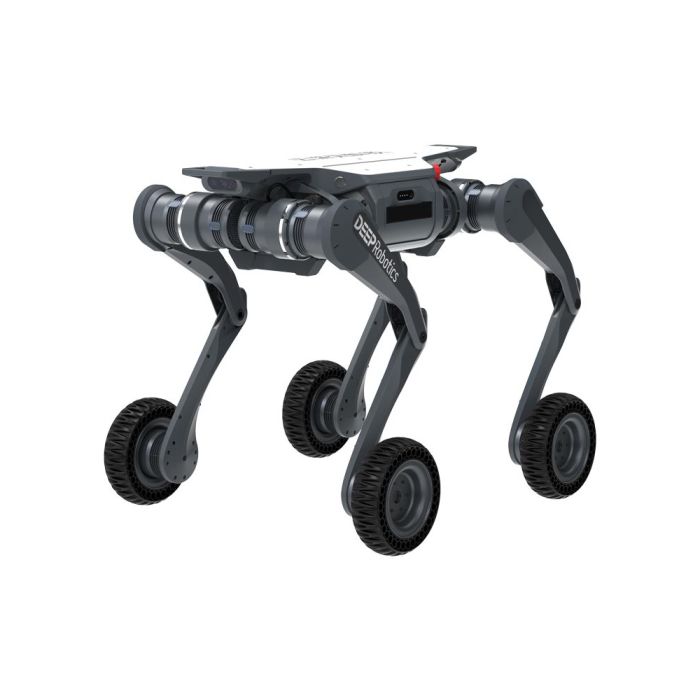
LYNX All-Terrain Quadruped Robot Dog (LYNX)
Company materials describe LYNX as a compact, agile platform intended to balance speed and agility through its distinctive wheel-leg motion, drawing on DEEP Robotics’ work in embodied intelligence and field deployment.
In public coverage and manufacturer descriptions, “LYNX” is used both as a platform name and as a series that includes models such as LYNX M20 (an industry-grade wheeled-legged robot for harsh environments). This article summarizes the LYNX platform concept and the commonly published specifications and capabilities associated with the LYNX line.
Design and Features
Wheel-leg locomotion and selectable mobility modes
A central engineering feature of LYNX is its use of wheels at the end of each limb, enabling it to roll efficiently on smoother surfaces and transition to more “leg-like” contact behavior when conditions worsen. Independent reporting describes LYNX as being able to lock wheels individually—rolling when that is faster and more energy-efficient, and switching to wheel-locked “foot” behavior in terrain where pure rolling is less effective.
This wheel-leg approach supports hybrid mobility behaviors such as rolling over long, firm stretches and then stepping or climbing through obstacles, debris, or uneven transitions.
All-terrain emphasis and obstacle capability
Manufacturer and third-party sources consistently emphasize obstacle performance. A DEEP Robotics LYNX page describes “wild performance” claims including up to 80 cm platform climbing, continuous 22 cm steps, and up to 5 m/s speed.
In a LYNX M20 user manual, related stair/step figures include 25 cm continuous stair height and 80 cm maximum single step (with slope capability up to ±45°, depending on flooring).
Coverage from heise similarly reports step and obstacle performance (up to 22 cm steps and 80 cm obstacles) and slopes up to 45°, describing the robot’s adaptive mode selection.
Environmental protection and field readiness
LYNX is marketed for outdoor and mixed-condition operation with published protection ratings that vary by model and configuration. One DEEP Robotics LYNX page lists IP54 protection and highlights hot-swappable dual batteries.
For the LYNX M20 series, DEEP Robotics describes IP66-rated protection and an operating temperature range of -20°C to 55°C, positioning it for harsh industrial environments.
These claims indicate that environmental sealing and ruggedization are core to the LYNX product positioning, though exact ratings depend on the specific model.
Perception sensors and autonomy-oriented stack
The LYNX M20 user manual describes the robot as being equipped with two wide-angle cameras, two laser radars, and two industrial-grade high-performance hosts used for motion control and environmental perception computation.
On the manufacturer’s LYNX M20 series page, DEEP Robotics additionally highlights a 96-line LiDAR and “omnidirectional obstacle avoidance,” along with “auto navigation.”
Together, these descriptions place LYNX (especially the M20 line) in the category of field robots designed for sensing-driven mobility and semi-autonomous task execution.
Technology and Specifications
Core platform characteristics (published)
DEEP Robotics’ general LYNX materials present the platform as a wheel-leg robot optimized for speed/agility tradeoffs and rugged terrain, with headline figures such as:
-
Speed: up to 5 m/s (as a claimed top speed)
-
Obstacle/step capability: continuous 22 cm steps and up to 80 cm platform climbing (claims)
-
Protection: IP54 (listed on one LYNX page)
-
Hot-swappable battery system: emphasized as “quick-swap dual batteries”
LYNX M20 series (manufacturer specifications)
For the LYNX M20 series, DEEP Robotics provides more explicit “industry-grade” positioning and a published spec block including:
-
Standing dimensions: 820 mm × 430 mm × 570 mm
-
Weight (incl. battery): 33 kg
-
Payload capacity: 15 kg; and a listed max load capacity: 50 kg
-
Stair capability: 25 cm stairs (described as “climbs 25cm stairs”)
-
Protection & environment: IP66, -20°C to 55°C
-
Autonomy: “auto navigation” with “omnidirectional obstacle avoidance” (as described)
LYNX M20 (user manual technical details)
The LYNX M20 user manual adds engineering-level parameters and system details such as:
-
16 degrees of freedom (DOF) via “4 motors on each leg”
-
Perception hardware: 2 wide-angle cameras + 2 laser radars (as stated)
-
Communication: Ethernet and Wi-Fi
-
Speed: maximum speed 5.0 m/s (noted as “extreme test”), and a maximum working speed 2.0 m/s
-
Terrain: slope up to ±45° (varies by flooring), continuous stair height 25 cm, and maximum climbable single step 80 cm
Applications and Use Cases
Industrial inspection and infrastructure operations
DEEP Robotics positions the LYNX M20 series for industrial operations in challenging terrains and hazardous environments, naming examples such as power inspection, emergency response, logistics, and scientific exploration.
In these settings, wheel-leg mobility can help traverse mud, rubble, narrow passages, and uneven ground while carrying cameras, sensors, or other payloads.
Emergency response and hazardous-area reconnaissance
Public reporting also highlights emergency and safety use cases, including rescue, fire detection, reconnaissance in unsafe areas, and area security/surveillance.
Such missions benefit from a mobile platform that can keep humans out of high-risk zones while maintaining situational awareness via cameras and ranging sensors.
R&D testbed for outdoor embodied mobility
Because wheel-leg robots inherently involve complex contact dynamics and mode switching, LYNX can also serve as a platform for research into terrain classification, adaptive gait selection, and robust motion planning in variable outdoor environments—especially for teams working on “embodied AI” concepts emphasized in DEEP Robotics’ product messaging.
Advantages / Benefits
Speed–agility balance via wheel-leg design
LYNX’s wheel-leg approach is explicitly framed as balancing speed and agility—rolling quickly where possible and adapting where necessary.
For practical deployments, that can translate into faster coverage of long routes (rolling) and improved resilience at terrain discontinuities (stepping/climbing).
High obstacle handling relative to many wheeled platforms
Repeated references to step and obstacle capability (including up to 80 cm obstacle/single-step figures in multiple sources) indicate a design target beyond typical small wheeled robots, which often struggle at curbs, rubble, and stairs.
Ruggedization options for real field work
The contrast between IP54 (general LYNX materials) and IP66 (LYNX M20 series page) suggests that the LYNX line includes more rugged industrial configurations intended for dust and water exposure.
Hot-swappable battery concept for sustained missions
DEEP Robotics’ materials emphasize quick-swap battery systems, and independent coverage notes replaceable batteries and multi-hour endurance expectations, supporting deployments where recharging downtime is impractical.
FAQ Section
What is the Deep Robotics LYNX all-terrain quadruped robot dog?
The Deep Robotics LYNX is an all-terrain quadruped robot that uses a wheel-leg mobility design to combine rolling speed with legged obstacle handling for outdoor and hazardous environments.
How does the Deep Robotics LYNX work?
LYNX rolls on wheels when terrain allows and can lock wheels to use them like feet for more difficult ground. Models such as the LYNX M20 are described as using multiple motors per leg (16 DOF) plus cameras and laser radars for perception and control.
Why is the Deep Robotics LYNX important?
Wheel-leg robots target a hard problem in field robotics: moving quickly across long distances while still handling rubble, steps, and irregular terrain. LYNX is positioned for industrial inspection and high-risk operations where mobility flexibility can expand reachable areas.
What are the benefits of the Deep Robotics LYNX?
Published and reported benefits include high speed (up to 5 m/s in extreme tests/claims), step/obstacle handling up to 80 cm (single-step/obstacle figures), steep slope capability (up to 45° in some sources), and ruggedization options (IP54 or IP66 depending on model).
Summary
The Deep Robotics LYNX all-terrain quadruped robot dog is defined by a wheel-leg mobility system designed to blend fast rolling with legged obstacle negotiation. Manufacturer materials and technical documentation emphasize step and obstacle handling (including up to 80 cm single-step/obstacle figures in multiple sources), steep slope capability (reported up to 45°), and field-oriented ruggedization that ranges from IP54 (general LYNX materials) to IP66 (LYNX M20 series positioning). With perception sensors and industrial use-case framing—especially in the LYNX M20 line—LYNX is positioned as a practical platform for inspection, hazardous-area response, logistics trials, and outdoor autonomy research where conventional wheeled robots face mobility limits.