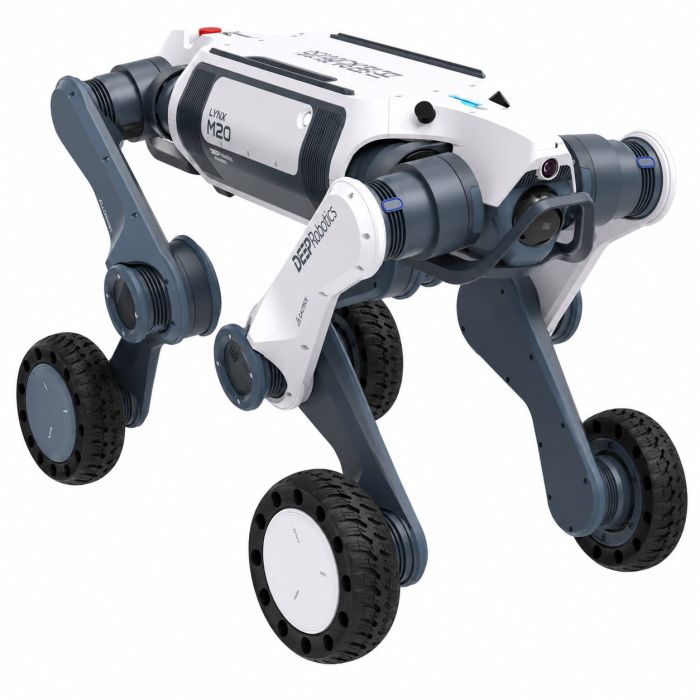
Deep Robotics LYNX M20 Omni Terrain Industrial Wheeled Quadruped Robot Dog
In stock
- BRAND:
- DEEP ROBOTICS
- MODEL:
- LYNX M20
- ORIGIN:
- China
- AVAILABILITY:
- ALLOW 2-4 WEEKS FOR DELIVERY
- SKU:
- Deep-Robotics-LYNX-M20
LYNX M20 Omni Terrain Industrial Wheeled Quadruped Robot Dog (LYNX M20)
The platform is marketed for industrial inspection, hazardous-environment operations, emergency response support, and field research, with an emphasis on ruggedization, autonomy-oriented sensing, and payload carriage.
DEEP Robotics positions the LYNX M20 as “industry-grade” and highlights an autonomy stack centered on dual 96-line LiDAR, wide-angle cameras, and onboard industrial compute, enabling omnidirectional obstacle avoidance and navigation features intended for complex outdoor and semi-structured environments.
Design and Features
Wheel-leg mobility and adaptive posture
LYNX M20’s defining design is its wheeled-leg (wheel-leg) locomotion, intended to blend speed with terrain adaptability. In manufacturer descriptions, the robot supports autonomous terrain recognition and adaptive gait control, dynamically adjusting posture and movement patterns to match the environment.
DEEP Robotics also describes posture transitions that enable traversal in constrained spaces—such as switching body configurations for tunnels, pipelines, and steps—supported by “hyper-flexible joints.”
Autonomy and perception suite
On the official LYNX M20 specification page, DEEP Robotics lists:
-
Dual 96-line LiDAR units (with a 360° × 90° field of view described on the product page)
-
Dual wide-angle cameras
-
Omnidirectional obstacle avoidance and point-cloud surround view
-
OTA upgrades and RF image transmission
Rugged industrial construction
Ruggedization is a core part of the M20’s positioning. DEEP Robotics lists IP66 protection and an operating temperature range of −20°C to 55°C, indicating suitability for dusty environments and exposure to strong water jets (while not necessarily supporting immersion).
Hot-swappable dual batteries
The LYNX M20 user manual describes the robot as powered by dual batteries and supporting replacement of either battery while the robot is powered on, a capability typically intended to reduce downtime during long missions.
Technology and Specifications
DEEP Robotics publishes a detailed parameter set for LYNX M20 on its official site. Key published specifications include:
Size, weight, and payload
-
Standing dimensions: 820 mm × 430 mm × 570 mm
-
Weight (incl. battery): 33 kg
-
Payload capacity: 15 kg
-
Max load capacity: 50 kg
Endurance, range, and charging
-
Unloaded endurance / range: 3 hours / 15 km
-
Loaded endurance / range (15 kg): 2.5 hours / 12 km
-
Charging time (single battery): 1.5 hours
Mobility performance (published)
-
Lab-tested maximum speed: 5 m/s
-
Operating maximum speed: 2 m/s
-
Max continuous stair height: 25 cm
-
Max single-step height: 80 cm
-
Max slope: 45°
Compute, sensors, and interfaces (published)
-
Computing power: Dual octa-core 64-bit industrial processors (16GB + 128GB) ×2
-
LiDAR: 2 × 96-line (listed with ~860,000 points/s on the official page)
-
Cameras: 2 × wide-angle
-
External interfaces: 72V power input and Gigabit Ethernet
Applications and Use Cases
Industrial inspection and maintenance
LYNX M20 is positioned for power and infrastructure inspection, including environments that combine long traversal distances with intermittent obstacles (stairs, debris, uneven ground). The platform’s published payload and rugged rating support the use of inspection payloads such as camera systems, thermal modules, or specialized sensors, depending on configuration.
Hazardous-area reconnaissance and emergency support
Third-party coverage and DEEP Robotics’ own positioning emphasize use in high-risk environments, where remote sensing and traversal can reduce human exposure. Features such as omnidirectional obstacle avoidance, point-cloud surround view, and RF image transmission align with reconnaissance and situational awareness tasks.
Logistics and field operations in mixed terrain
The M20’s wheel-leg design is suited to facilities and outdoor sites that include both smooth corridors/roads and rough segments, enabling efficient rolling where possible and step/obstacle negotiation when needed. Its continuous stair capability (25 cm) and slope rating (45°) are commonly cited for such mixed environments.
Research platform for embodied mobility
Because wheel-leg systems must coordinate rolling dynamics, contact transitions, and posture control, LYNX M20 can be used for R&D in terrain adaptation, robust navigation, and perception-guided locomotion—especially when paired with the published dual LiDAR and point-cloud mapping functions.
Advantages / Benefits
Wheel-leg efficiency plus obstacle capability
Compared with purely legged robots, wheel-leg designs can reduce energy cost on firm ground by rolling. Compared with purely wheeled robots, the LYNX M20’s stair and step specifications enable traversal across discontinuities that often stop wheeled systems.
Industrial payload and integration discipline
A published 15 kg payload (and mounting guidance in the manual) supports real inspection payloads and application-specific modules, while Gigabit Ethernet and a 72V power interface provide a straightforward integration path for field deployments and industrial test rigs.
Ruggedization for outdoor/dirty environments
The published IP66 rating and the manual’s operational cautions reflect a design intended for dusty sites and exposure to water jets (with warnings against immersion). This is particularly relevant for inspection and emergency operations where weather and contamination are common.
Reduced downtime via hot-swap battery workflow
Dual batteries with in-operation replacement capability can help sustain mission tempo in industrial workflows, where charging breaks can be operationally expensive.
FAQ Section
What is the Deep Robotics LYNX M20 Omni-Terrain robot dog?
The LYNX M20 is an industrial wheeled-legged quadruped robot designed for omni-terrain mobility, with dual 96-line LiDAR, cameras, and IP66 protection for harsh environments.
How does the LYNX M20 work?
It uses articulated legs with wheels to combine rolling efficiency with adaptive posture and stair/obstacle handling. DEEP Robotics lists omnidirectional obstacle avoidance and point-cloud surround view supported by dual 96-line LiDAR and onboard industrial processors.
Why is the LYNX M20 important?
In industrial robotics, the toughest challenge is reliable mobility across mixed terrain. LYNX M20 targets that gap by combining wheel-leg locomotion, rugged IP66 construction, and autonomy-oriented perception for field operations.
What are the benefits of the LYNX M20?
Published benefits include 15 kg payload, 2.5 hours / 12 km under load, IP66 protection, 25 cm continuous stairs, 80 cm single-step capability, 45° slope, and dual 96-line LiDAR for obstacle avoidance and mapping functions.
Summary
The Deep Robotics LYNX M20 is an omni-terrain industrial wheeled quadruped robot dog built around a wheel-leg mobility system that prioritizes both fast traversal and obstacle resilience. Official specifications highlight a 33 kg platform with 15 kg payload capacity, IP66 environmental protection, dual 96-line LiDAR with point-cloud mapping functions, and published mobility performance including 25 cm continuous stairs, 80 cm single-step capability, and 45° slopes. With hot-swappable dual batteries, industrial compute, and practical integration interfaces, the LYNX M20 is positioned as a field-ready platform for inspection, reconnaissance, and demanding outdoor operations where conventional wheeled robots or purely legged robots may face limitations.